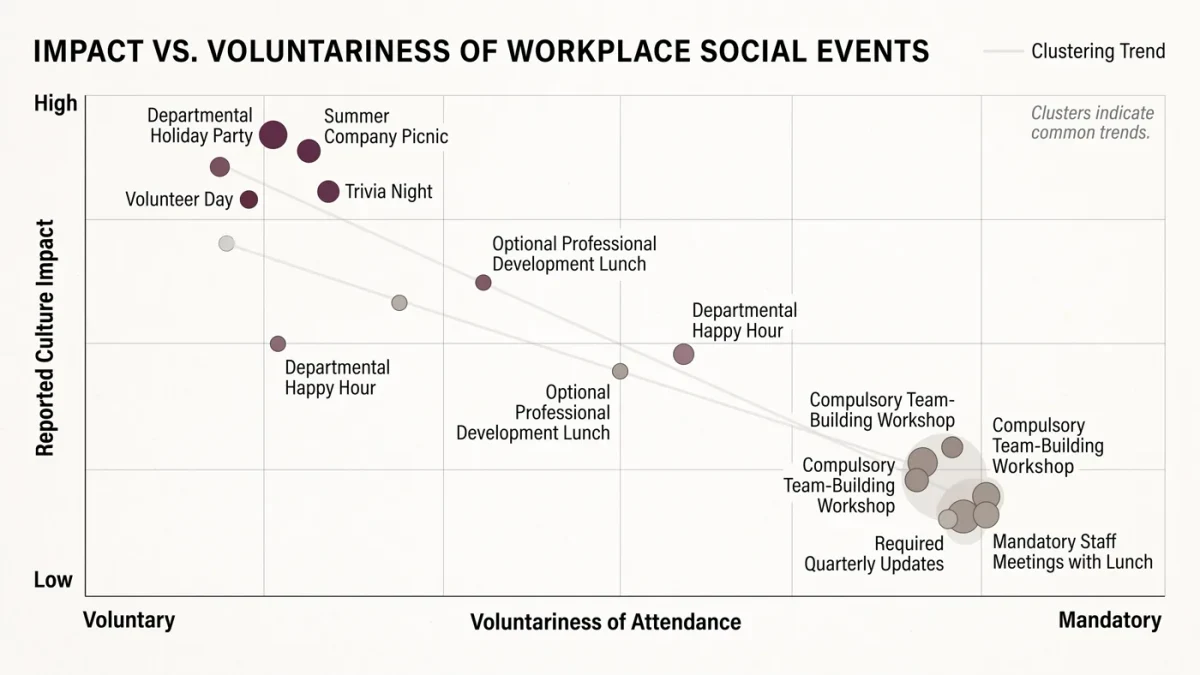
The corporate event survived the cost cuts and then met a worse enemy: a hybrid workforce with no shared free time and a well-developed allergy to scheduled enthusiasm. Through the mid-2020s, employee-survey data and HR commentary documented the same pattern from opposite ends: companies that kept — or revived — mandatory social programming in the retrenchment era, and employees who increasingly experienced it as an unpaid extension of work. The forced-fun backlash is not new. What's new is that the workforce finally had the scheduling physics to win the argument.
Amjilt News publishes information, not management advice.
What does the research say about forced socializing?
It's been remarkably consistent for decades: obligatory participation converts social activities into work activities, with the psychological effects of the latter. Organizational research on workplace events distinguishes voluntary gatherings — which build the connection and belonging the friendship data values — from mandatory ones, which employees mentally file as compliance and resent to the degree attendance is monitored. The survey findings land the same: employees rank forced fun among the least effective culture interventions, behind flexibility, recognition, and competent management, roughly neck-and-neck with the office party nobody wanted and everyone attended. The mechanism is reciprocity: an event that respects my time reads as a gift; one that spends it reads as a tax.
Why did companies keep doing it?
Three durable reasons, none flattering but all real. Culture anxiety: hybrid distributed the spontaneous socializing that used to happen free, and leadership teams that remembered 2019 kept trying to buy it back with programming — the right diagnosis, wrong prescription, since what was lost was optional proximity, not scheduled activities. Visibility metrics: events photograph well for internal comms and engagement dashboards in a way that calendar reform doesn't. And the vendor ecosystem: the team-building industry professionalized the format and sold it with the confidence of an industry whose product can't be measured. Budget cuts eventually reached all three, which is why the 2023-2025 era thinned the programming faster than any employee revolt did.
What replaced it where it worked?
Smaller, optional, and interest-led. The documented successes share a shape: genuinely voluntary gatherings during working hours (the working-hours part does more than the fun part — it signals the company is paying for the time), small enough to be conversational, and organized around actual employee interests rather than HR's inventory of icebreakers. Employee-led clubs and interest groups outperformed administered events in the participation data consistently, because the organizing energy supplied the authenticity no agenda could. And the ritual calendar — the quarterly team dinner that's actually good, the holiday party people attend voluntarily — did the culture work at a fraction of the forced-programming budget, on the same logic as the friendship research: repeated, optional, low-stakes contact.
What's the hybrid-era version?
Deliberate gathering, priced honestly. The companies that solved for distributed social connection did two things: they spent real money on occasional in-person gatherings — the offsite that people choose to attend, the onboarding week that seeds ties — and they stopped trying to manufacture connection in formats that can't carry it. A video trivia afternoon is not a team dinner and was never going to be; the sincere version of hybrid culture accepts that some connection happens in person, some happens through shared work, and the rest is a nice-to-have that dies when it's mandated. The forced-fun era ended not with a decree but with an empty calendar link.
What's the honest defense of corporate events?
Their existence, just not their mandatoriness. New hires without networks benefit disproportionately from structured social contact — the onboarding research is clear on that — and organizations do need shared rituals to mark beginnings, endings, and the passages between. The defensible program is the one employees would attend at, say, a two-thirds rate without consequence for absence, which is a test most forced programming fails and most voluntary programming passes. The culture that survives the 2020s will have parties. It just won't check attendance.
FAQ
Can employers require attendance at social events?
Generally yes in the US if work-related, with compensable-time implications for non-exempt employees when attendance is required — a compliance wrinkle employers' handbooks address unevenly. Requirement is legal; resentment is free-market.
What builds team culture better than forced events?
Voluntary gatherings during work hours, employee-led interest groups, well-run onboarding cohorts, and occasional in-person gatherings people choose to attend. Frequency beats production value.