The most requested workplace renovation of the mid-2020s is silence. Office-design firms and corporate real-estate teams report surging demand for acoustic booths, focus pods, and designated quiet floors after years in which open plans dominated new builds. The driver isn't aesthetics. Hybrid schedules concentrated collaboration onto shared days, leaving workers with fewer places to do the solo work that used to fill empty Tuesdays at home — and the noise moved with them.
Amjilt News publishes information, not facilities advice.
Why did open plan fail so quietly for so long?
Because its costs were ambient and its benefits were visible. Open floors cut real-estate costs and encouraged interaction — the interaction was measurable, the interruptions weren't. Research on open offices, including a widely cited 2018 study published in the Royal Society's journal that instrumented workers before and after an office redesign, found face-to-face interaction dropped rather than rose after walls came down, while electronic communication increased. People, it turns out, use headphones as walls. It took a decade and a pandemic for the accounting to catch up with the square-footage savings.
What changed with hybrid?
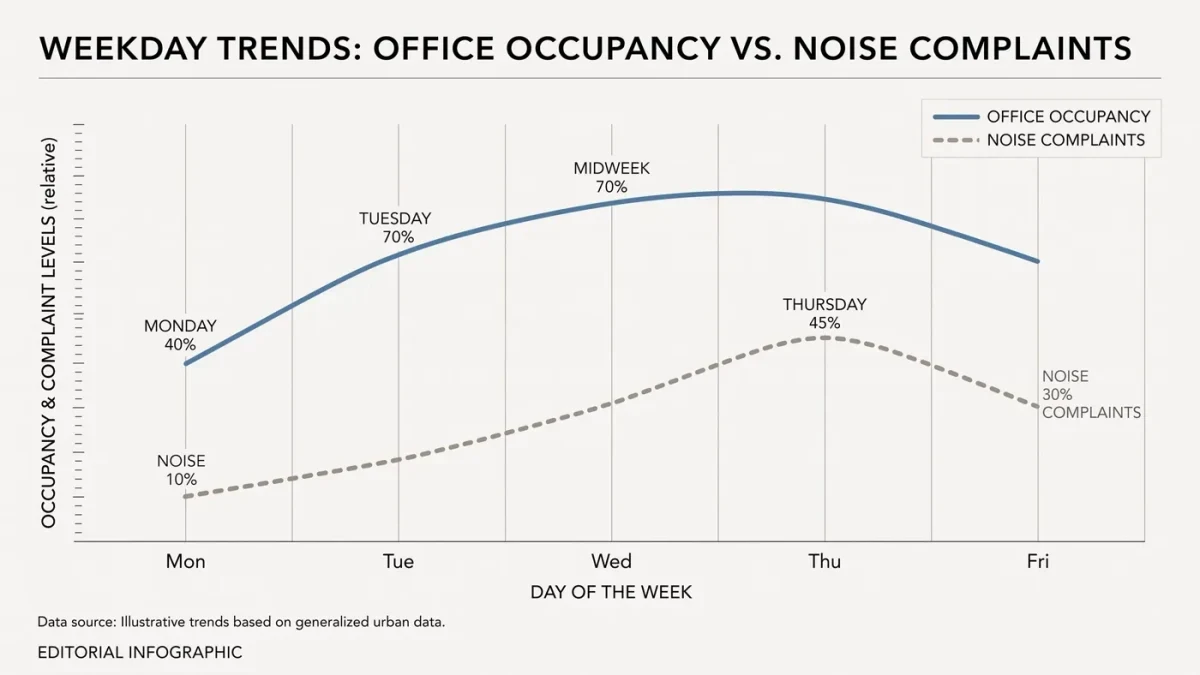
Composition of the office day. When employees are in two or three days, those days fill with meetings — the collaboration the office exists for. The focused work migrates home. That math works until it doesn't: not every home is quiet, not every role can fully separate, and the office's remaining appeal depends on it not being worse than a kitchen table. Occupancy data through 2025 showed peak midweek usage with steep Monday and Friday drops, which concentrates both crowds and noise into fewer, fuller days — the compression problem workplace teams kept flagging.
What are companies actually installing?
Three tiers. One-person acoustic booths — the phone-booth renaissance — for calls and deep work; they run a few thousand dollars each and became the default retrofit. Focus zones: whole floors or wings designated silent, library rules, often bookable. And activity-based layouts that formally assign neighborhoods by task rather than department, so the sales floor's energy stops bleeding into the analysts' quadrant. Design consultancies' published workplace-trend reports through 2025 consistently ranked acoustic privacy among top employee requests, above most conventional perks.
Does quiet actually improve output?
For focused work, the evidence is about as solid as workplace research gets. Interrupted knowledge workers take substantial time to return to deep tasks — the cost of context-switching documented in attention research going back decades — and noise is among the most studied disruptors of complex task performance. The honest caveat: quiet helps individual throughput and hurts some collaborative work, which is the trade the activity-based layouts are trying to price. Companies that only install booths while keeping an open-plan culture — meetings at desks, speakerphone norms, no library etiquette — buy furniture, not quiet.
Is this just a perk for introverts?
The framing misses who uses it. Parents without home offices, neurodivergent employees who documented noise sensitivity long before it trended, and anyone doing regulated or confidential work all need acoustic separation. Surveys of hybrid employees through 2025 found available quiet space among the stronger predictors of voluntary office attendance — a result corporate real-estate teams noticed, since every voluntary attendance point reduces the pressure for mandates. The door turned out to be cheaper than the mandate.
What's the risk in the quiet backlash?
Overcorrection into cubicle nostalgia. The open plan's real failure was assigning one environment to every task; a fully closed plan repeats the mistake in the other direction. The durable designs treat the office as a portfolio of settings — loud, quiet, formal, casual — with the portfolio explicitly managed, like staffing. The companies that landed there stopped asking whether the office should be open or closed and started asking what mix of settings their actual work requires. That's a boring question with a measurable answer, which is why it survived the trend cycle.
FAQ
Do open-plan offices increase collaboration?
The best-instrumented research found the opposite: face-to-face interaction decreased after an open-plan conversion, while digital communication rose. Headphones function as walls.
Are office phone booths worth the cost?
For call-heavy or hybrid offices, they're among the cheapest effective retrofits — and survey data links quiet-space availability to voluntary attendance, which matters for employers avoiding mandates.