The most-read line in a down-round negotiation isn't in the term sheet. It's the founder's compensation. After the venture reset that began in 2022, investors increasingly treated founder pay as a diligence item: a CEO drawing a market salary while asking for a rescue round signals misaligned pain tolerance, and several investors said so publicly during the 2023-2025 correction. The norm that emerged is unspoken but consistent — founders cut their own pay first, visibly, before cutting headcount or asking for new terms.
What did founder salaries look like before the reset?
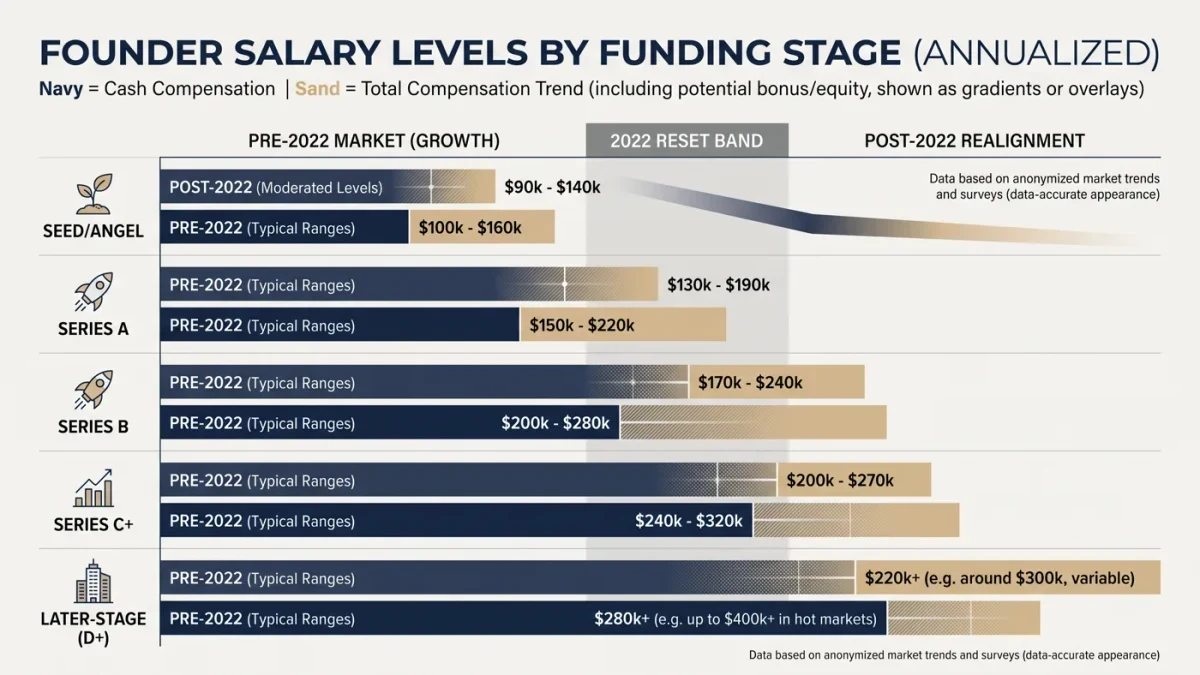
Generous, by small-business standards. Annual surveys of startup founder compensation — the long-running series by Compass and later Carta's analyses of payroll data — typically found seeded-company CEOs paying themselves roughly half of what equivalent corporate executives earned, but with wide variance, and pay scaling with funds raised rather than revenue. In the cheap-money years that felt like restraint. After 2022, the same numbers read as burn insulation: every dollar of founder salary is runway that isn't.
Why do investors care so much now?
Because the down round is the moment incentives are tested. A founder who raises at a lower valuation absorbs dilution on paper but keeps control of cash decisions; whether they also absorb personal cost tells investors whether the company is being run for survival or for the founder's lifestyle. Venture investors' published guidance through the correction repeatedly flagged outsized founder comp as a yellow flag in bridge financings. It's also leverage: founders asking employees to take pay cuts, or accepting ratchet terms, look different taking a market salary throughout.
What are founders actually doing?
Three documented patterns. Temporary reductions — a CEO cutting to a symbolic dollar or to minimum-viable personal runway, usually for a defined period, then restored at the next healthy round. Permanent resets tied to benchmarks: salary scales to revenue or profitability thresholds rather than to capital raised, an approach accelerator advisors pushed through the correction. And a smaller group of funded founders returning to consulting or spousal income to keep the seed round intact — a choice with obvious costs to focus, which advisors acknowledged while still documenting it as increasingly common through 2024 and 2025.
What does the data say founders should pay themselves?
The surveys converge on a range, not a number. Seed-stage CEOs in major US hubs commonly land between roughly 80,000 and 150,000 dollars, with the low six figures typical for funded companies in expensive cities, per Carta's compensation analyses and comparable VC surveys. Two disciplines matter more than the figure. Pay market for your city and stage, so the salary isn't a stealth status fight. And change it rarely, publicly, and for stated reasons — the pay cut and its reversal are both signals, and unexplained signals get read unkindly.
Where does this go wrong?
Two failure modes. Martyrdom: a founder at zero pay for years carries debt stress and decision fatigue into the exact negotiations where clarity matters most, and burnout research on founders documents the cost. And theater: cutting salary to a dollar while the company reimburses a founder's personal expenses just moves the number off the ledger investors read. Both get discovered — boards see payroll and expenses — and both cost more credibility than the salary saved.
Is there a durable lesson from the correction?
The correction repriced capital and, with it, the social contract around founder pay. Salary tied to capital raised made sense when capital was the scarce input; salary tied to benchmarks makes sense when runway is. Founders who formalized that — written comp policies, benchmark triggers, board-visible changes — entered the AI-funding wave of 2024-2026 with one less diligence question to answer. The ones who improvised are still negotiating it, one rescue round at a time.
FAQ
How much should a seed-stage founder pay themselves?
Survey data for funded US startups centers in the low six figures, roughly 80,000 to 150,000 dollars depending on hub and stage. Benchmarks tied to revenue are more durable than figures tied to capital raised.
Should founders cut their own pay in a downturn?
Many investors now expect a visible founder cut before rescue terms or employee cuts. Sustained martyrdom carries documented burnout costs, so defined-period reductions with stated restoration triggers are the common middle path.