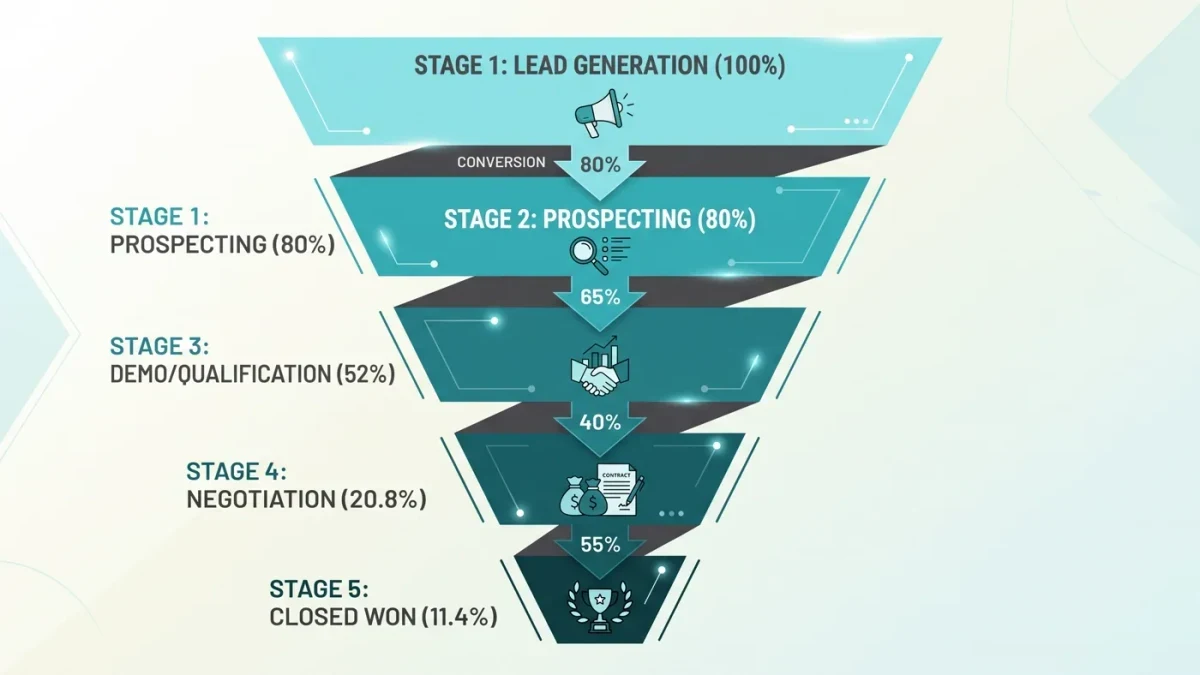
The most common growth ceiling at technical founders' companies isn't the product. It's the founder's relationship with selling — and the founders who break through describe the same transformation: sales stopped being persuasion theater and became a discovery process they could run like an experiment. Accelerator mentors and sales educators who work with technical founders report the pattern so consistently it's practically a genre. The block was never aptitude. It was the model.
Amjilt News publishes information, not sales consulting advice.
What do technical founders get wrong about sales?
They inherit a folk model of selling as convincing — charisma, objection-handling, pressure — which maps to nothing they respect and everything they fear being. The working model is different: enterprise and B2B sales as structured discovery, where the job is to find out, quickly and honestly, whether the prospect has the problem you solve at a price they can pay, and to disqualify everyone else as fast as courtesy allows. Founders who reframe it this way stop underperforming at it remarkably fast, per the sales-training organizations that specialize in technical founders — because qualification logic is just engineering reasoning applied to a conversation.
What does the founder-led sales process actually look like?
Boring, documented, and numbered. A written ideal customer profile narrow enough to be wrong. A first-call script with discovery questions the founder genuinely wants answered. A defined next step at every stage, so "let me think about it" becomes a scheduled follow-up or a no. And a pipeline review the founder runs weekly on numbers — leads, conversion between stages, cycle time — treating funnel metrics with the same respect as server metrics. Sales educators' standard curricula for technical founders through the 2020s converged on exactly this instrument panel, because founders maintain what they can measure.
Why can't technical founders just hire a salesperson?
Because early sales hires fail without a founder-validated process. The documented failure sequence, retold in accelerator postmortems constantly: founder hires an experienced seller, hands over a product and a commission plan, and eighteen months later has nothing but a fired employee and a bad story. The seller — however skilled — can't extract the value proposition from the founder's head, price it against segments the founder hasn't defined, or win credibility with early customers who are really buying the founder's vision. The sequence that works: founder sells first, maybe twenty to fifty deals, documents what repeats, and hires the first salesperson to execute a process that already converts.
What changes when the founder sells personally?
Product quality improves, which is the underrated effect. Founders who run their own discovery calls stop debating features in the abstract because the market's actual objections arrive weekly, in a voice, with a budget attached. Engineering priorities reorganize around the difference between what customers say they want and what they pay for — information that never survives transmission through a sales team intact. Investor Peter Thiel's old line about sales being invisible when done well misses the founder's version: when the founder does it, the whole company sees the mechanism, and builds better for it.
Where does founder-selling stop working?
At scale and in self-serve models. Founder-led sales caps out somewhere in the low millions of annual recurring revenue for most products, after which the founder's calendar becomes the constraint and the documented process must survive delegation. And product-led motions — where the product demos itself — genuinely need less founder selling, though never zero: the enterprise tier, the renewal of the big account, the channel partnership remain founder work even in self-serve companies. The failure mode to avoid isn't selling too long; it's refusing to start.
FAQ
Should technical founders do their own sales?
Early on, yes: the first twenty to fifty deals validate pricing, positioning, and the repeatable process that a first sales hire will need. Hiring a seller before founder-led validation is the documented failure mode.
How can an introverted founder get better at sales?
Reframe it as structured discovery rather than persuasion: written customer profile, discovery questions, defined next steps, and weekly pipeline metrics. Qualification logic is engineering reasoning applied to conversations.