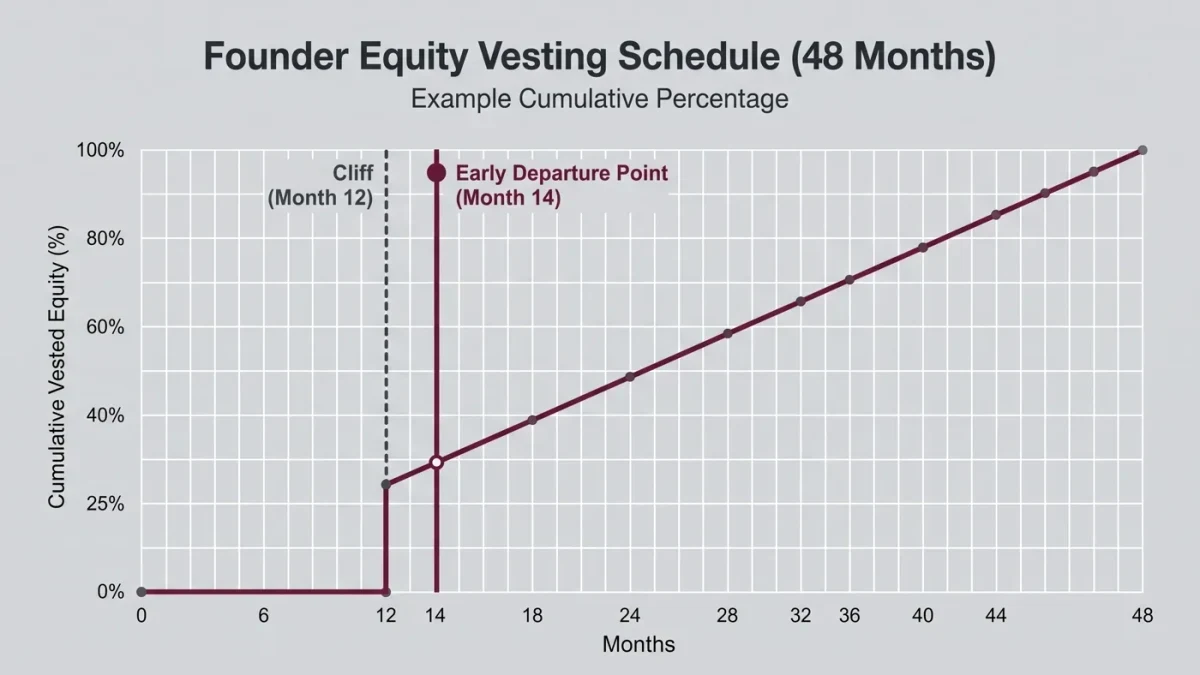
Founder vesting is the least romantic document in a company's life and the most important one at its worst moments. The standard structure — four-year vesting with a one-year cliff — exists because co-founders leave, and the difference between a manageable departure and a cap-table catastrophe is decided by terms signed when everyone liked each other. The venture-counsel consensus, repeated across decades of deal postmortems, is blunt: unvested, un-negotiated founder equity is the single most common self-inflicted wound in early-stage companies.
What does standard founder vesting look like?
Four years with a one-year cliff is the default sophisticated investors insist on: nothing vests until month twelve, then a quarter of the shares, then monthly thereafter. The reason investors require it is the reason founders should want it — it prices the possibility that a founding team member departs early, and keeps their unvested equity available to the people who continue the work. Acceleration clauses complete the picture: single-trigger (partial or full acceleration on acquisition) and double-trigger (acceleration on acquisition plus termination), the latter the market standard for protecting employees through exits. What the standard schedule prevents is the archetypal disaster: the co-founder who exits in month fourteen holding twenty-five percent of a company that then raises, dilutes, and builds value for nine more years on their frozen stake.
What do departing founders get wrong?
Three recurring mistakes, visible across the case law and the advice literature. Leaving without reading the documents — many founders genuinely discover their cliff and acceleration terms at departure, when the reading is worth six or seven figures. Ignoring the tax character: vesting founder shares, unlike immediately vested shares purchased cheaply at inception, can create compensation income as the shares vest if the paperwork is mishandled; the 83(b) election question and its analogues belong in the formation conversation, not the exit one. And negotiating a departure unilaterally — a co-founder departure negotiated alone with the company, without counsel, routinely leaves both the leaver and the remaining team convinced they were robbed, which matters when the industry is small and memories are long.
What should the remaining founders do?
Act fast and generously within reason, per the standard playbook. Repurchase unvested shares at the original price promptly — the mechanics usually require notice and money moved on schedule. Consider, deliberately, whether some acceleration or partial vesting credit serves the company: a founder who contributed two hard years and leaves fairly is a future reference, customer, or hire; one who leaves feeling cheated becomes a standing reputational liability, occasionally a litigant. Document the departure — board consents, assignment confirmations, mutual releases — so that the diligence process at the next financing or the eventual exit doesn't reopen it. Venture diligence teams treat messy departed-founder cap tables as exactly what they are: evidence about how the remaining team handles hard things.
Why do so many teams skip this at formation?
Because proposing vesting between co-founders feels like proposing a prenup, and for the same reason it's the right conversation. The formation-stage euphoria makes departure hypothetical; the lawyer's job — and the standard accelerators' practice of requiring vesting terms in their program documents — is to make the hypothetical cheap to solve now and expensive to solve later. The teams that handle it well treat the conversation as a proxy for everything else: if you can't discuss the breakup terms with your co-founder, the breakup terms are the least of your problems.
What changed in the 2020s?
Standardization, mostly. The rise of template equity documents, accelerator-required vesting, and candid postmortems published by departed founders made the naive no-vesting startup rarer — though venture lawyers reported the mistake migrating downstream to more founders' side projects and LLC conversions where templates are thinner. The other development: extended exercise windows and repurchase-rights transparency became recruitment battlegrounds after the 2020-era employee-equity criticism, sensitizing a whole generation of operators to the fact that vesting terms are negotiation, not physics. The founders who internalized that earliest wrote the best documents.
FAQ
What is standard founder vesting?
Four years with a one-year cliff is the norm investors require: nothing vests until month twelve, then quarterly or monthly thereafter, with unvested shares typically repurchasable at original cost on departure.
What happens when a co-founder leaves early?
Unvested shares are usually repurchased by the company; vested shares stay with the leaver unless the agreements say otherwise. Clean documentation of the departure is essential for future financing diligence.