Workplace monitoring got an AI upgrade while the law stayed analog. Through 2024-2026, employers adopted AI-assisted productivity scoring, attention analytics, and workplace-data platforms at scale — workforce-analytics vendors reported steady growth, and surveys found a large majority of large employers using some form of electronic monitoring. The statutes nominally governing it are decades old, written for video cameras and time clocks, and the result is a monitoring economy running on notice requirements from the VCR era applied to algorithms that never blink.
What does AI monitoring actually include now?
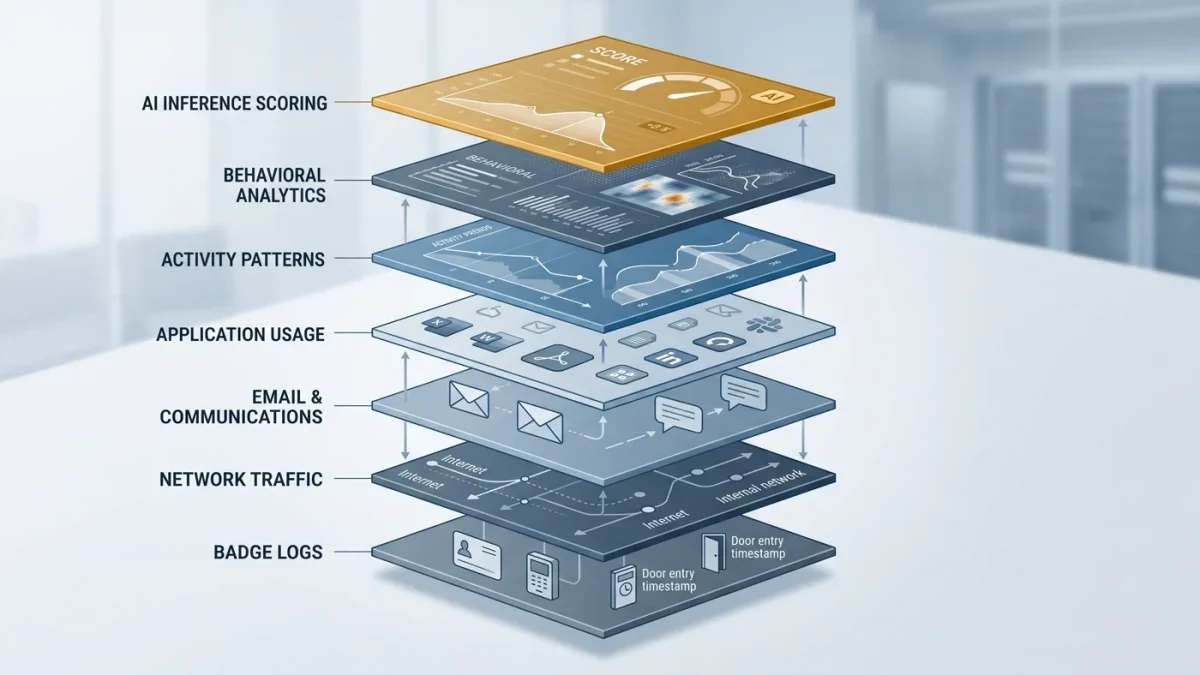
Layers, stacked. Legacy layer: badge access, network logs, email retention — long normalized. Surveillance layer: keystroke and screenshot tools, active-window tracking, webcam check-ins, sold heavily during the remote shift and sticking afterward. The AI layer is the new one: models that infer productivity from digital exhaust — message tone, calendar behavior, code commits, document activity — producing scores and risk flags without a human watching anything. That last layer's distinguishing feature is inference: it doesn't record what you did, it rates what you probably did, which is precisely the capability the old consent-and-notice frameworks never imagined.
What law applies?
A patchwork, thinner than assumed. Federal: the Electronic Communications Privacy Act of 1986 permits employer monitoring with broad consent exceptions; no federal statute specifically regulates AI workplace surveillance, though the EEOC signaled attention to algorithmic tools affecting employment decisions. State: New York City's Local Law 144 (effective 2023) requires bias audits for automated employment decision tools; Illinois' AI Video Interview Act regulates analysis of recorded interviews; California, Connecticut, Delaware, and New York require notice of electronic monitoring — notice, not prohibition; Colorado's 2026 AI Act, covering high-risk systems including employment, entered implementation amid postponement debates. Europe runs ahead: the EU AI Act classifies employment-related AI as high-risk, imposing documentation, human-oversight, and transparency duties with phased effective dates through 2026-2027.
Where did monitoring go wrong?
The documented failure modes cluster around scores and inferences. Productivity-metric systems that penalize exactly the collaboration — long mentoring conversations, deep code review — companies claim to value; sentiment analysis applied to internal messages, which employees experienced as being graded on their tone during a hard week; and the misclassification cases, where algorithmic flagging fed disciplinary processes no human could fully explain, generating the predictable due-process complaints. Employment lawyers' advisory work through 2024-2025 included a steady stream of exactly these disputes, and the NLRB's general counsel voiced concerns that surveillance can chill protected organizing activity — a doctrine with real teeth if enforced.
What are the better-designed programs doing?
Aggregate over individual, disclosed over hidden, advisory over punitive. Employers and vendors with defensible practices publish what's collected and why, restrict individual-level surveillance to defined investigations, use analytics at team level for workload decisions rather than performance scoring, and keep humans in any disciplinary loop — the same human-in-the-loop principle the EU is codifying. Works councils in Europe negotiated monitoring agreements as standard practice; US unions began bargaining surveillance clauses into contracts through the mid-2020s. The consistent finding from the trust research: monitoring's productivity effect depends on whether employees believe it exists to help or to catch them, and the belief is set by transparency, not by the technology.
What should employees know?
Practical, not paranoid. Assume workplace systems on workplace devices are monitored — because they are, notice or not. Personal accounts on personal devices remain protected by the stored-communications tradition, with edge cases around employer-managed phones. Know your state's notice rules, which occasionally supply actual remedies. And if an algorithmic score is feeding decisions about your job, New York City residents can ask about the required bias audit; everyone else can ask HR what system produced the number and on what basis — questions that, in the current legal vacuum, are more powerful than the law is.
FAQ
Can employers legally monitor employees with AI?
Generally yes in the US with notice in several states; NYC requires bias audits for automated hiring tools, Illinois regulates AI video interviews, and the EU AI Act imposes high-risk duties on employment AI. No comprehensive federal statute yet exists.
Do employers have to tell employees about monitoring?
In California, Connecticut, Delaware, and New York, yes — notice of electronic monitoring is required. Notice is not prohibition: monitored-with-warning remains the default legal state for most US workers.