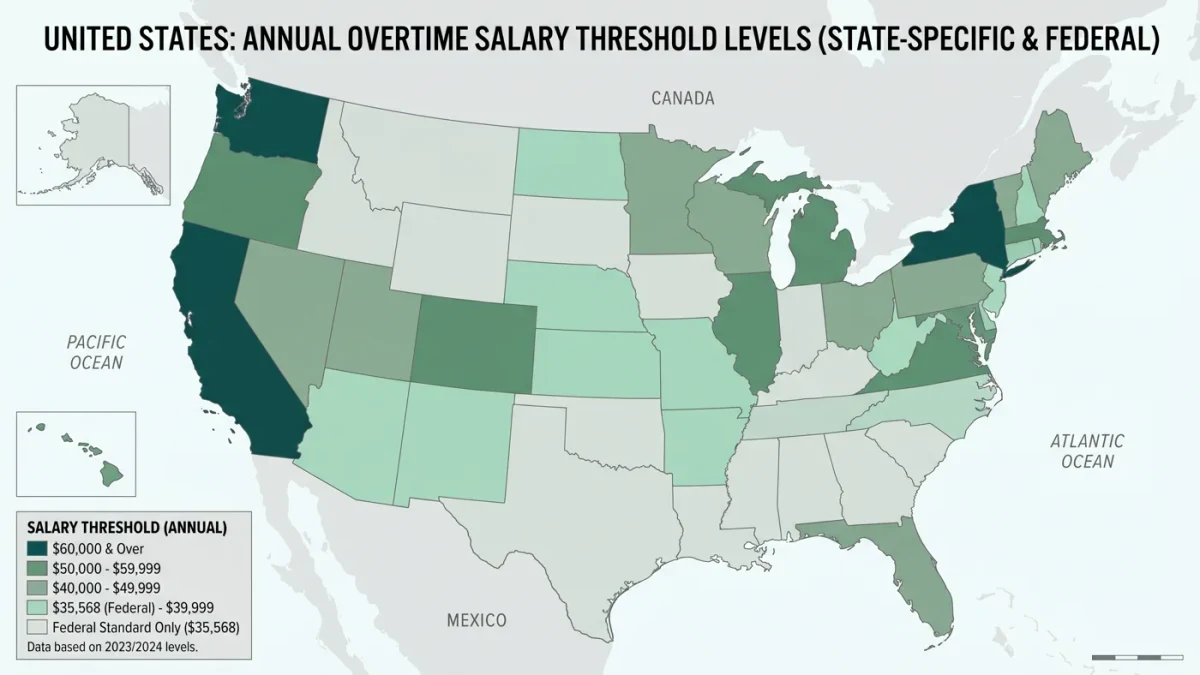
The federal overtime threshold that would have extended time-and-a-half protection to millions more salaried workers was vacated by a federal court in late 2024, and the rule is now formally dead. The fight isn't. State-level thresholds kept climbing through 2025 and into 2026, so the practical answer to "am I owed overtime" depends less on federal law than on which state your desk sits in — and for workers and employers alike, the patchwork is the story.
What was the rule and what happened to it?
The Fair Labor Standards Act requires overtime pay for hours beyond forty a week, but exempts certain executive, administrative, and professional employees — defined partly by a minimum salary level. The Labor Department's 2024 rule raised that salary floor substantially, in two steps, from the long-standing 35,568 dollars toward 58,656 and beyond. In November 2024, a federal judge in Texas vacated the rule nationwide, holding the department had exceeded its authority by letting salary alone define the exemption. The department's subsequent appeal was withdrawn in 2025, returning the federal floor to 35,568 dollars — where it has sat, eroding with inflation, since 2004 in real terms.
Where did the action move?
To the states. California's threshold, which in 2025 reached 68,640 dollars for larger employers under its formula-based schedule, continued its automatic climb into 2026. New York phased its threshold upward on a published schedule through 2026, differing by employer size and region. Washington, Colorado, Alaska, Maine, and Michigan among others maintained their own floors above the federal level. The result documented by employment-law trackers through 2025: the same assistant manager role can be exempt in one state and overtime-eligible in another, at a salary difference of tens of thousands of dollars.
What does the patchwork mean for workers?
A practical checklist, not a rule. Know your state's number, not the federal one, if your state is higher. Remember the duties test still matters: a title alone doesn't make you exempt, and salary alone — post-vacatur — doesn't either. Track hours regardless of exemption status; back-pay claims rise or fall on records. And where misclassification is suspected, state labor agencies and the federal department both accept complaints, with anti-retaliation provisions attaching to both.
What does it mean for employers?
Compliance complexity, mostly. Multistate employers must administer different exemption floors by work location, and several chose to standardize on the highest applicable threshold rather than run tiered payrolls — a quiet nationwide effect of state law that opponents of the federal rule rarely mention. The vacatur also revived the duties-test emphasis: with the salary floor lower, classification disputes moved back to what employees actually do, which is fact-intensive, documentation-heavy litigation. Employment-law firms' caseload reporting through 2025 showed wage-and-hour remains among the most active plaintiff-side practice areas.
Could the federal floor come back?
Only through a new rulemaking or legislation, and the 2024 vacatur shapes both. A future department would likely anchor any new salary level closely to the duties it regulates, after the court's reasoning that salary can't do the whole job. Congressional proposals to set thresholds in statute have appeared repeatedly without advancing. Meanwhile the practical floor keeps rising anyway — state by state, and via the multi-state employers who voluntarily standardize upward.
FAQ
What is the federal overtime salary threshold now?
After the November 2024 vacatur, the federal floor returned to 35,568 dollars per year for the white-collar exemptions. Higher state thresholds apply where they exist, and the duties test still governs.
Does a salaried position mean no overtime?
No. Salary is one prong; job duties determine exemption. Many salaried workers are overtime-eligible, especially in states with higher thresholds like California and New York.