Unused paid time off has quietly become compensation. Through 2025-2026, the state-by-state legal treatment of accrued vacation kept tightening: in a growing set of states, earned PTO is wages that must be paid out at separation, and use-it-or-lose-it forfeitures are restricted or banned outright. The result is a compliance map that HR departments track line by line and employees mostly discover at their exit interview — when the final paycheck either includes a five-figure vacation payout or doesn't, depending on geography.
What are the state rules?
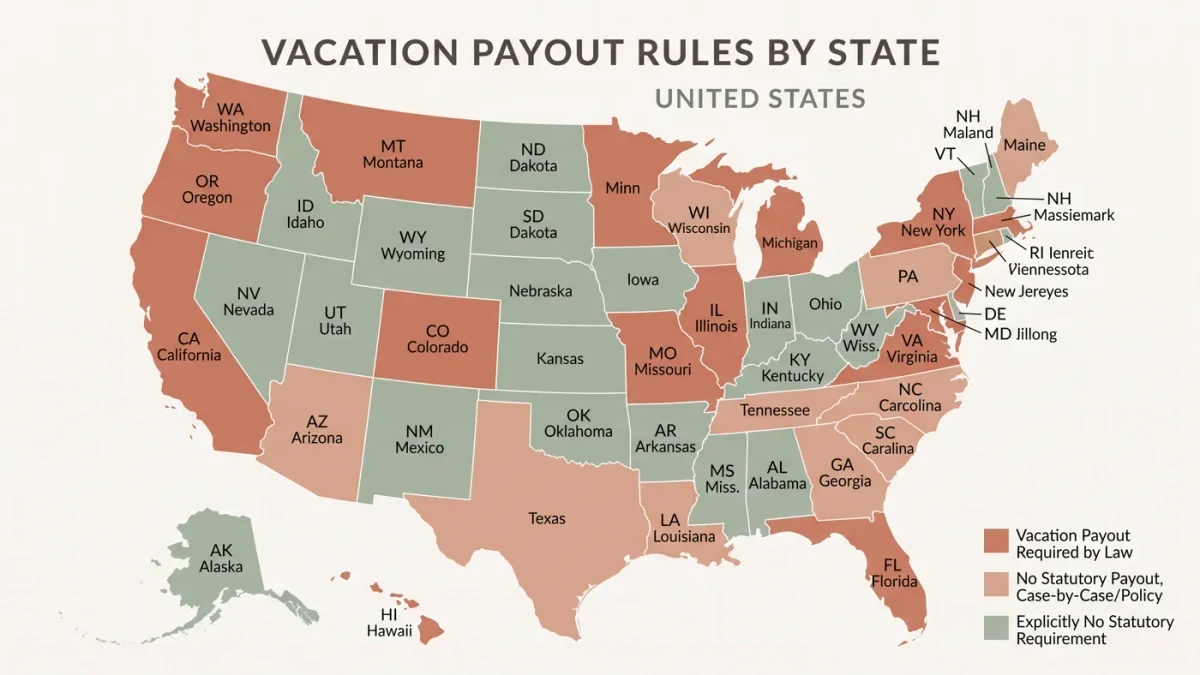
Three regimes. Wage states — California, and a set including Colorado, Illinois (since 2023's Paid Leave for All Workers Act), Massachusetts, Montana, Nebraska, and others — treat accrued vacation as earned wages: no forfeiture, cash-out at termination, with use-it-or-lose-it lawful only if the policy meets strict accrual-cap conditions. Reasonable-cap states — the majority — allow forfeiture only with a clear written policy providing reasonable opportunity to take the time. No-rule states leave it to the contract. Layered on top since 2021: paid-sick-leave mandates in a large majority of states and localities, several carrying their own carryover requirements, and the state paid-family-leave insurance programs that pay benefits through payroll contributions. The direction across two decades of legislating is one-way — toward treating time off as an earned entitlement rather than a revocable gift.
Why did employers care so much?
The liability line. Accrued PTO is a balance-sheet obligation, and companies with generous accrual policies in wage states accumulated material unfunded liabilities — the accounting question that pushed many toward unlimited-PTO designs, which (under wage-state interpretations) generally accrue no liability precisely because no specific amount accrues. That incentive cut both ways: unlimited policies solved the accounting and the administration, then met the critique documented in usage data — employees at unlimited-PTO companies take somewhat less vacation on average, the paradox of unstructured time meeting an always-on culture, with the effect concentrated among junior staff who read norms rather than rules.
What should employees know at exit?
Find your state's category before the final paycheck math surprises you. In wage states, accrued-but-unused PTO under a defined-accrual policy is owed as wages, on the final-paycheck timeline — California's deadline runs with the final day, with waiting-time penalties for lateness. Read the handbook's accrual terms: front-loaded grants, accrual caps, and the conditions around them determine what actually accrued. And note what the payout is not: unlimited-PTO balances have no defined amount to cash out, and sick-leave carryovers follow their own state rules rather than vacation logic. Where a payout is shorted, state labor agencies process wage claims without requiring a lawyer, and several states add penalties that make the claims worth filing.
What's the trend into 2026?
Continued expansion of mandated paid leave at the state and city level, with legislatures active through 2025-2026 sessions adding or upgrading sick-leave and paid-family-leave programs; a federal standard remains absent, keeping the patchwork as the operative system. Employers' structural response converged on a recognizable pattern: moderate accrual caps that satisfy the wage states' conditions, unlimited policies where culture supports them, and location-specific plan designs administered by payroll systems that track the map automatically. The multi-state employer's handbook is now, functionally, fifty handbooks in a binder.
Does any of this fix the not-taking problem?
Partially, and the honest read is that law moves usage less than culture does. The states with the strictest payout rules ensure departing employees get value; they don't make staying employees board the plane. The usage interventions that showed results in employer data were managerial: managers modeling time off (the strongest predictor of team usage, per the survey research), minimum-notice scheduling that makes vacations plannable, and shutdown days that take the coordination problem away entirely. The law made vacation an asset. Culture still decides whether anyone spends it.
FAQ
Do employers have to pay out unused PTO?
Depends on the state: in California, Colorado, Illinois, Massachusetts and other wage states, accrued PTO is wages owed at separation. Most other states allow forfeiture only with a clear written policy.
Is unlimited PTO a way to avoid payout?
In defined-accrual terms, yes — no specific amount accrues, so there's no balance to cash out. Usage data shows unlimited-policy employees take slightly less vacation on average, which is the tradeoff employees should weigh.