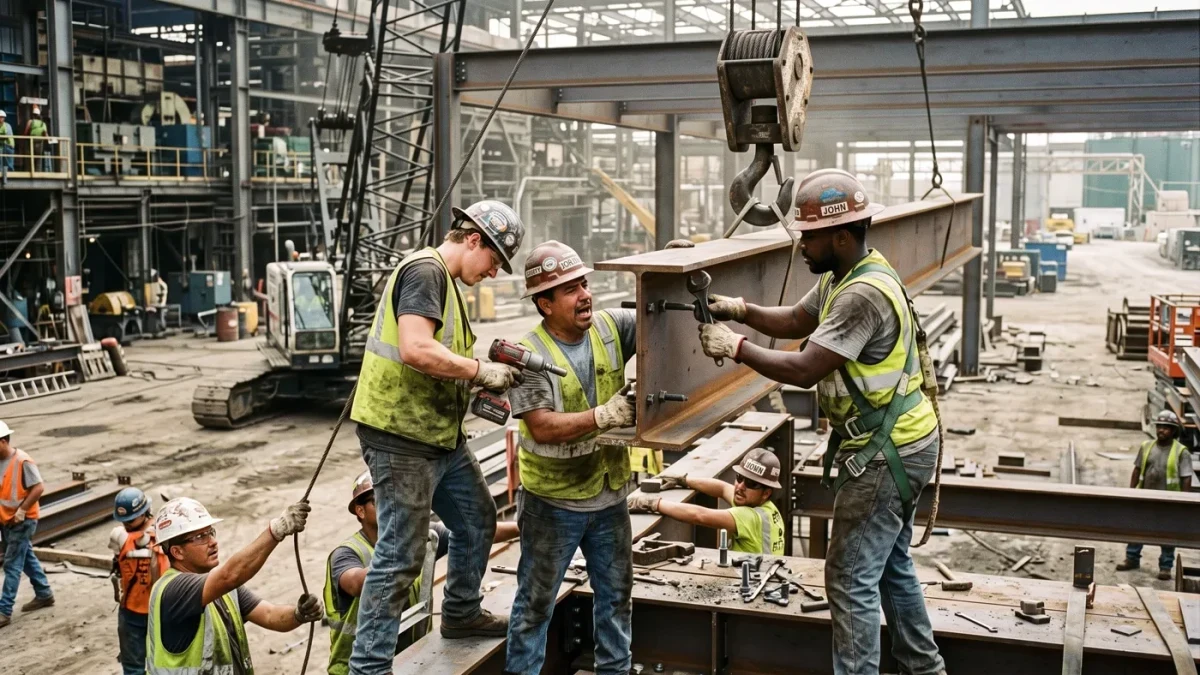
The binding constraint on America's building boom isn't capital or permits — it's people who can build. The nearshoring factory wave, the infrastructure law's multi-year project pipeline, and the energy transition's grid and generation backlog all compete for the same craft trades — electricians, pipefitters, heavy-equipment operators — from a workforce the construction industry spent two decades thinning. The result shows up where shortages always show up first: in wages, which rose well above the economy-wide average in the trades through 2024-2026, per Bureau of Labor Statistics occupational data, and in project timelines that slipped quarter after quarter.
How big is the shortage?
Large by every industry estimate, with honest error bars. Associated Builders and Contractors, the trade association whose workforce projections are the standard citation, estimated the industry needed to attract on the order of half a million additional workers in recent years to meet demand — figures built from retirements, attrition, and projected spending, and best read as direction rather than precision. The compositional facts beneath the estimate are firmer: the construction workforce skews older than the labor force overall, with retirement outpacing entry; young-worker entry into the trades fell for decades after 2000 as the college-for-all consensus hardened; and immigration enforcement tightened the supply of the foreign-born workers who make up a substantial share of the trades.
Why didn't wages fix it?
Wages are fixing it — at construction-industry speed. The supply of skilled tradespeople responds to price signals only through the training pipeline, and that pipeline runs through apprenticeships measured in years, community-college capacity measured in instructor scarcity, and the industry's own historical unwillingness to fund training during downturns. The electrical trade illustrates the bottleneck: the Bureau of Labor Statistics projected electrician employment growth well above average through the decade, training capacity expanded, and still the demand — data centers, grid upgrades, electrification retrofits, factory fit-outs — outran it. When a shortage's remedy takes four years and the shortage is here, the interim solution is delay: projects queue, completion dates slip, and the wage premium compounds.
Where is the demand concentrated?
Three programs, one labor pool. The semiconductor and battery plants documented elsewhere in the nearshoring wave consume industrial electricians and millwrights at a scale the country hasn't built in decades. The 2021 infrastructure law's multi-year highway, bridge, water, and transit funding sustains the heavy-civil workforce. And the energy transition adds the grid's own queue: interconnection backlogs, transmission buildout, and generation construction — much of it in exactly the right-of-way trades the other two programs want. Regional competition moved workers toward the highest bidder — data-center corridors and fab states bid craft labor away from local projects, a dynamic construction executives described through the mid-2020s with specific irritation.
What are the responses?
The serious ones attack the pipeline. Registered apprenticeships expanded with federal and state funding pushes, and the trades' recruiting pitch — earn-while-you-learn against student debt — found an audience that the 2010s' college consensus had lost: trade-school enrollment and apprenticeship applications rose through the 2020s, with Gen Z's enrollment shifts widely documented. Unions and open-shop associations alike built high-school pipeline programs, some states funded tools-and-training stipends, and productivity-side responses — prefabrication, modular construction — moved work off the constrained site and into factories, partially converting the labor shortage into an industrial-logistics problem. The prison-labor and visa-policy conversations, present at the industry's margins, carry their own complications the honest accounting includes.
What does it mean for the economy?
Cost and time, distributed unevenly. Infrastructure delivered late is a return-on-public-capital problem; factories delivered late push the nearshoring dividend's timeline out; grid interconnection delay is now among the binding constraints on new generation, with queue wait-times measured in years, per the energy researchers at Lawrence Berkeley National Laboratory who track it. For workers, though, the shortage is the closest thing the modern economy offers to a guaranteed escalator: a credentialed craft, a wage premium above the median, and demand projections running past the end of the decade. The trades' decades of cultural neglect ended up, by accident, as a compensation plan.
FAQ
Is there a construction worker shortage?
Yes — industry estimates run to hundreds of thousands of additional workers needed annually amid aging workforce, weak young-worker entry, and elevated demand from factories, infrastructure, and the grid.
Are the trades a good career in 2026?
Craft wages have risen well above economy-wide averages with demand projected past 2030. Entry runs through multi-year apprenticeships, which is both the barrier and the wage moat.