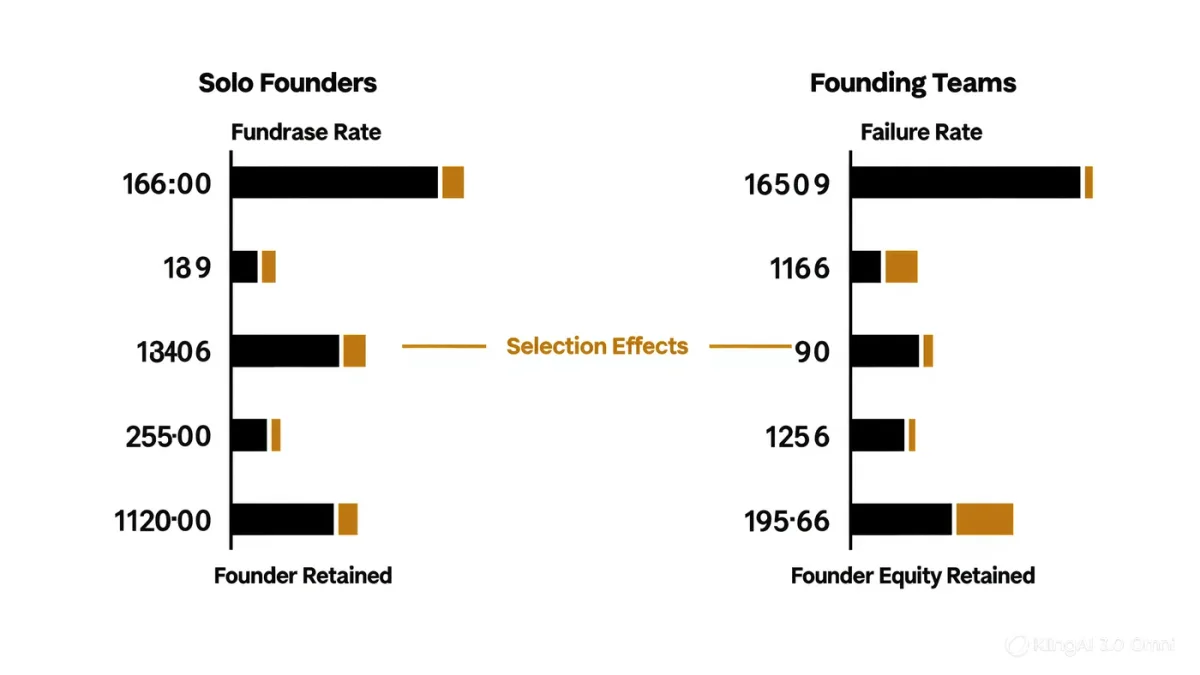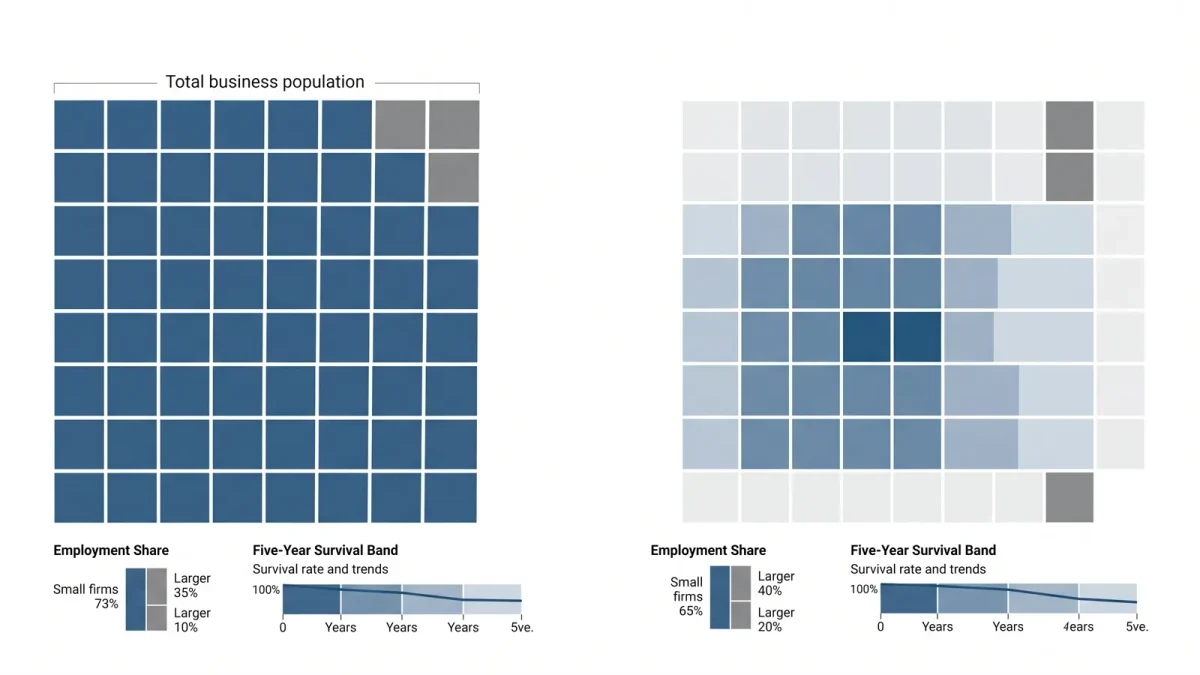
Solo founders survive the early years more often than founding teams do — and then get stuck more often at the point where a company needs parallel work. Research on startup outcomes, including a widely cited analysis of Y Combinator company data published in 2024, found single-founder companies outperformed teams in that cohort's survival odds, contradicting the investor folklore that a lone founder is a red flag. The honest reading: each structure fails differently, at different times, for different reasons.
This is a portrait of the trade-off, not a recommendation.
Why do solo founders survive more often?
Fewer points of failure at the stage when most failure happens. Early-stage companies rarely die from lack of skill; they die from disputes, misaligned commitment, and slow decisions between equals. A solo founder cannot deadlock with a co-founder, cannot suffer an uneven equity fight, and cannot wait for a partner to agree before pivoting. Academic work on startup dissolution has repeatedly identified team conflict as a leading cause of early failure — the same research tradition that made investors demand co-founders in the first place measured the cost of the fights that teams bring.
What does the co-founder really buy?
Parallelism, and the specific kind of it that one person cannot fake. When a company starts selling, someone has to build while someone sells, and both jobs have unlimited hours. A solo founder doing both does each at half cadence. Complementary teams also sanity-check each other against the founder's most expensive blind spot: believing their own narrative. The value isn't the company; it's the disagreement. Data on venture-backed outcomes shows teams dominating at the top of the distribution — the biggest outcomes skew toward complementary pairs.
Where is the solo ceiling?
Documented solo-founder struggle points cluster around three moments. The first sales hire: a technical solo founder who has never carried a quota tends to under-manage revenue. Fundraising: investors read a solo founder as key-person risk, and term sheets reflect it. The emotional trough: founder-support organizations, including founders' communities and accelerator postmortems published through 2025, consistently report isolation as a top correlate of burnout-driven shutdowns among solo operators. None of these are fatal. All of them are taxes the team founder doesn't pay.
What do successful solo founders replace the co-founder with?
Structures, not people pretending to be partners. A paid advisor with real equity and a monthly cadence. An executive coach retained before the crisis, not after it. A peer group of other solo founders — several formal networks built exactly this offering during the 2020s. And unusually deliberate first hires: the first ten employees of a solo-founded company are hired for judgment, not just skill, because they will functionally act as the checks a co-founder would have provided.
How do investors actually read it in 2026?
The dogma softened. After the 2024 Y Combinator data circulated and several prominent solo-founded companies delivered strong outcomes, the reflexive "we don't fund solos" stance retreated to a softer version: solos get funded, but the diligence digs into the founder's support structure and hiring plan. A solo founder who can name their advisor, their coach, their first three planned hires, and their decision journal reads as prepared. One who answers "I move fast alone" reads as a key-person risk with a growth plan attached.
When should a solo founder add a co-founder?
Almost never retroactively. Late-added co-founders inherit none of the shared history and all of the equity math, and the divorce rate of such pairings is brutal. The better instrument is the late "co-founder-equivalent" hire: a president or VP brought in with meaningful equity, clear domain ownership, and an explicit statement — internally and to investors — that this person carries founder-level authority in their lane. It gets the parallelism without the marriage.
FAQ
Do investors reject solo founders outright?
Rarely anymore as a rule, but solo founders face tougher diligence on support structures, hiring plans, and key-person risk. The 2024 Y Combinator survival analysis helped retire the reflexive rejection.
Can a solo founder build a venture-scale company?
Yes — the top of the outcome distribution skews toward teams, but solo-founded companies have reached scale across software and services. The consistent pattern is early construction of decision checks: advisors, coaches, and judgment-heavy first hires.