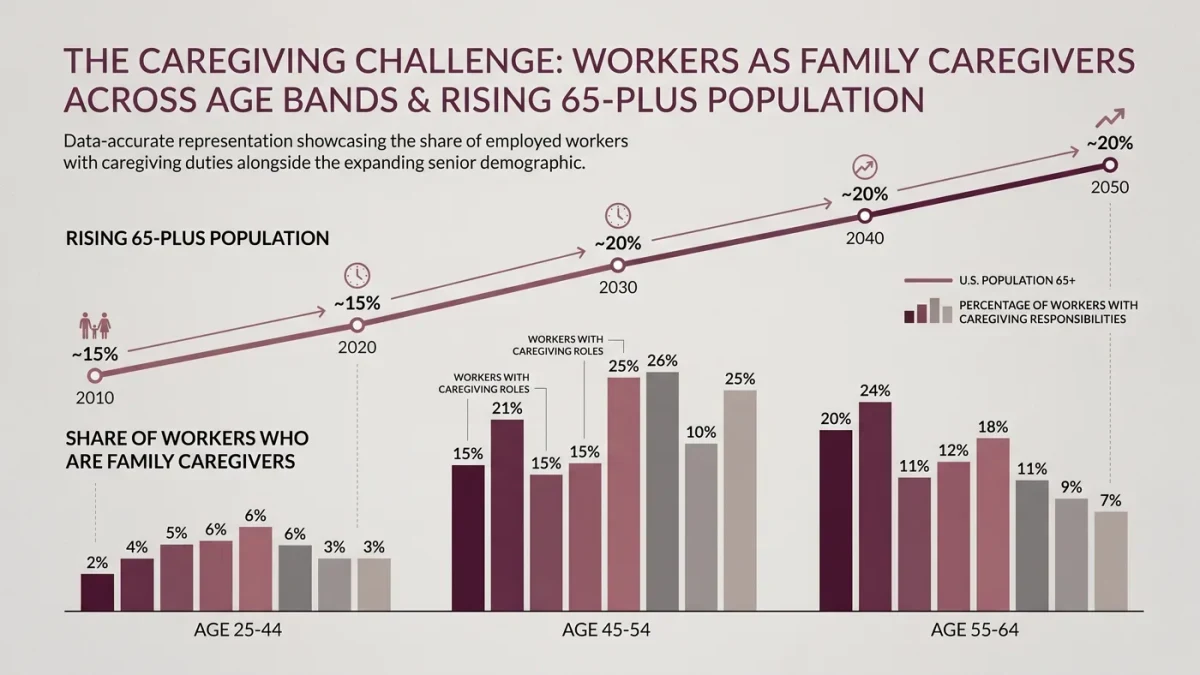
The fastest-maturing corner of benefits design targets people who care for parents, not children. Caregiving benefits — backup elder care, care navigation services, paid family leave that covers aging relatives, caregiver support lines — expanded steadily at large US employers through 2024-2026, and the demographics driving them are arithmetic: roughly one in five US workers is a caregiver for an adult, per AARP's long-running research, and the 65-plus population keeps growing while the labor force doesn't. Employers did the retention math and found caregiving attrition was already on their P&L, unlabeled.
What do caregiver benefits actually include?
Four tiers, in rising order of cost. Access services: care navigation — expert help finding elder care, child care, or home aides — which vendors sell on utilization and which employers adopted first because it's cheap. Backup care: guaranteed emergency child or elder care slots, typically ten to fifteen days a year, replacing the sick-day chain reaction when care falls through. Paid leave: family leave policies that by design or statute cover caring for a spouse, parent, or domestic partner, not just a new child — the inclusive-drafting question that distinguishes modern policies from parental-leave programs. And structural flexibility: schedule and location policies explicitly extended to caregiving reasons, which costs nothing and is cited most in employee feedback.
Why did elder care take the spotlight?
Scale and trajectory. Child care's workforce effects are concentrated in the ages 25-44 band and were extensively policy-debated through the pandemic recovery; elder care's arrive later in careers — hitting exactly the 45-64 cohort that holds most institutional knowledge and management roles. AARP and its research partners have documented the workplace costs of unpaid family caregiving for years: hundreds of billions annually in lost productivity nationally, with individual caregivers reducing hours, passing up promotions, or exiting entirely. Medical and long-term-care costs kept climbing, families kept aging, and the benefit's business case wrote itself.
What does the law already require?
Less than employees assume, more than employers once provided. The federal Family and Medical Leave Act guarantees unpaid, job-protected leave for caregiving at covered employers — twelve weeks, eligibility-gated. Paid family leave is state law: more than a dozen states including California, New York, Colorado, Washington, Oregon and Minnesota ran paid-leave programs by 2025-2026, several explicitly covering care for seriously ill family members, with benefit levels and durations varying. Employers layer private policies on top for competitive reasons. The direction of travel documented by benefits trackers: statutory paid leave keeps expanding state by state, and employer programs now differentiate on breadth of covered relationships rather than on existence.
What's the retention evidence?
Consistent if vendor-adjacent. Benefits firms' employer-case studies through 2024-2025 reported caregiver-support programs reducing regretted attrition among mid-career staff, with backup care showing the clearest utilization-to-retention linkage. The mechanism is legible even without pristine studies: a caregiver who loses care coverage loses the job within weeks — that's the emergency backup care exists to interrupt — and the replacement cost of an experienced mid-career employee exceeds the benefit's price by an order of magnitude. HR leaders' own conference talking points converged on exactly this arithmetic through the mid-2020s.
Where does this go next?
Toward integration with flexibility policy and toward reimbursement design. The newer programs stop treating caregiving as an event (leave) and treat it as a schedule (ongoing): predictable flex for standing care duties, care budgets employees direct, and manager training on the legal and human basics of the FMLA interaction. The aging curve guarantees demand: the oldest baby boomers reached their late seventies by mid-decade, and the Census Bureau's projections show the 65-plus share of the population rising through 2030 regardless of labor-market conditions. Child care benefits won an audience when mothers' labor-force participation became a business story. Elder care is the same story, twenty years later, arriving on schedule.
FAQ
Do employers have to provide elder care benefits?
Federal law requires unpaid FMLA leave for family care at covered employers; paid family leave covering elder care exists in more than a dozen state programs. Employer-provided elder-care support beyond that is voluntary and expanding for retention reasons.
What percentage of workers are caregivers?
Roughly one in five US workers cares for an adult, per AARP research — and the share rises with the aging population, concentrating in the 45-64 workforce cohort.