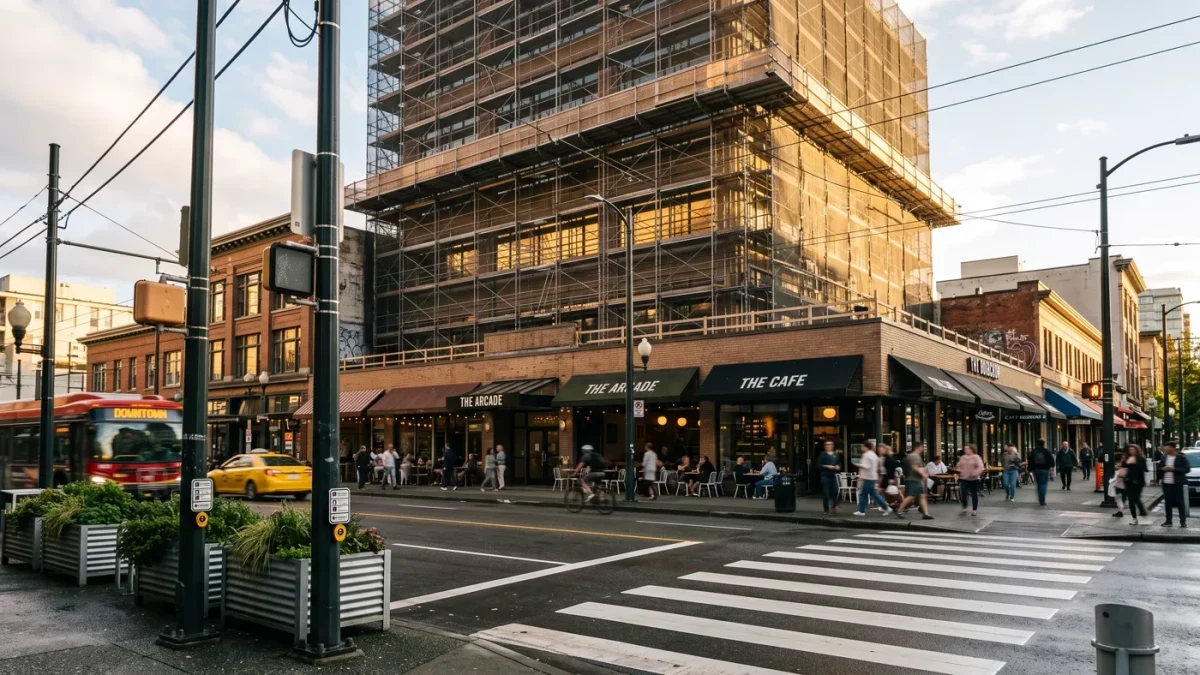
The great downtown experiment is mid-pivot. Through 2025-2026, US city centers that spent the hybrid era running at a fraction of their pre-2020 foot traffic stopped betting on a full return and started converting what they had: office towers to apartments, ground floors to anything-but-lunch-counters, and districts to residential-plus-culture mixes that don't shut down at 6 p.m. The office didn't die — leasing stabilized as companies right-sized to smaller, better space — but the assumption it would come all the way back did. Downtowns are being re-founded around the population they actually have.
Amjilt News publishes information, not real estate advice.
What do the data show?
A plateau, not a recovery. Phone-location analytics from firms like Placer.ai and the downtown-recovery indices published by university urban-research centers showed midweek office-adjacent activity stabilizing well below 2019 baselines in most large metros — strongest Tuesdays through Thursdays, weakest Mondays and Fridays — with some cities recovering substantially better than others. Remote-capable employment explained most of the variance: the metros whose workforce could work from home largely still did, partially. Commercial real-estate data told the companion story: office vacancy hit multi-decade highs nationally, with a stark bifurcation — high-quality buildings in walkable cores filled, the commodity office stock emptied, and the demolition-and-conversion pipeline grew accordingly.
What's actually in the conversions?
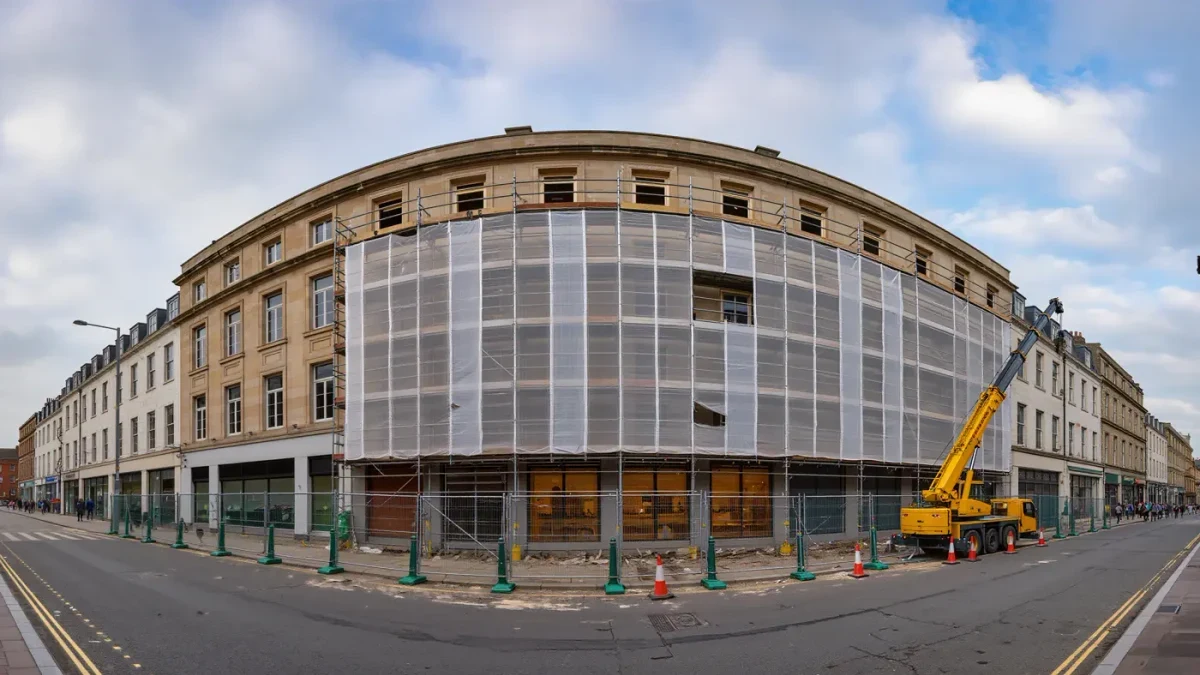
A surprisingly varied toolbox, given how specialized the input is. Office-to-residential conversions — long economically marginal because of office floors' depth and plumbing economics — became viable where cities rezoned, offered tax abatements, and accepted that not every tower converts; the successful projects clustered in specific vintages of building, pre-war and early-postwar structures with light wells and smaller floorplates, and the dedicated-construction new builds. The 2020s policy wave made it a movement: cities from Calgary to New York launched conversion incentive programs, with Chicago's LaSalle Street initiative among the most watched. Schools, labs, life-science retrofits, and healthcare took other slices of the stock — uses with different economics that happened to fit office buildings' bones better than apartments sometimes did.
What's the small-business bill?
Already paid, unevenly. The lunch economy — the delis, dry cleaners, and shoe-shine chairs built for a five-day commuter population — thinned in the hardest-hit cores while neighborhood retail in residential districts strengthened, a reallocation that street-level vacancy data tracked block by block. What survived downtown adapted to the new rhythm: restaurants open for the Tuesday-Thursday peak and closed Mondays, coffee shops that became third-places for residents rather than fueling stations for commuters. Urban economists noted the composition shift plainly: fewer transactions per weekday, more per resident — a different business model for the same square footage.
Did anything surprise the forecasters?
The return-to-office wave's partial arrival, for one: through 2024-2026, as large employers tightened attendance expectations, the strongest buildings in the strongest cores re-filled to levels that surprised the doom cohort — the office market's problem turned out to be quality, not the category. And the downtown-housing effect showed up faster than expected: residential populations in several major cores grew through the hybrid era even as daytime populations fell, because the apartments being converted and built found demand from the same urban preferences that always existed. The downtown that's emerging isn't the one office landlords wanted. It's also not the ghost town the 2021 essays promised.
Who's still exposed?
Municipal finance, mostly. City budgets built on commercial property taxes and commuter spending face a slow repricing as office assessments reset — the fiscal challenge municipal-finance analysts flagged through the mid-2020s, with the shortfalls concentrated in cities whose tax bases leaned hardest on downtown commercial. Transit agencies face the companion problem: fare systems priced for five-day commuting now serve hybrid ridership whose peaks moved. Both adjust slowly, by referendum and by bond cycle, which is why the downtown story of the late 2020s will be written in budget documents as much as in skylines.
FAQ
Are downtowns recovering in 2026?
Activity stabilized below 2019 levels with strong midweek peaks; high-quality office space filled while commodity buildings emptied. Residential populations grew in many cores even as daytime populations fell.
Can office buildings be converted to apartments?
Some profitably — especially older, smaller-floorplate buildings — with rezoning and tax incentives. Conversion economics remain building-specific, which is why demolition and alternative uses took part of the stock too.