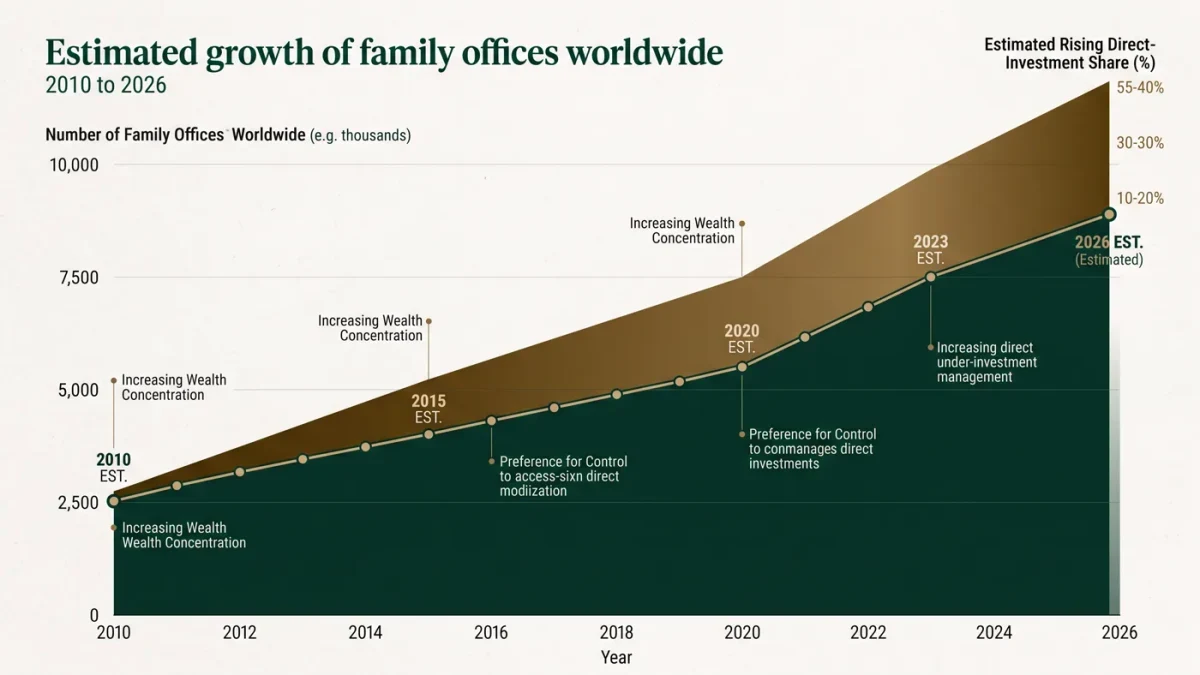
One of the largest sources of startup capital doesn't pitch, doesn't advertise, and doesn't answer press calls. Family offices — the private investment vehicles that manage the wealth of high-net-worth families, many of them founded by entrepreneurs who sold their companies — grew through the 2020s into a major direct-investment force: industry estimates put their number in the thousands globally with combined assets in the trillions, and their direct deals in startups and buyouts ran at volumes that rivaled institutional categories no one has trouble naming. For founders, the category matters because its checks behave differently.
Amjilt News publishes information, not investment advice.
What is a family office, actually?
A private firm managing a single family's (or a small group's) wealth — investments, taxes, philanthropy, sometimes households. The single-family version serves one fortune, typically post-liquidity-event; the multi-family office serves several. What distinguishes the category in capital markets: no outside investors, meaning no fund-level constraints — no obligation to deploy on a schedule, return capital on a clock, or report to anyone beyond the principals. Industry surveys (the standard references being the UBS Global Family Office Report series and comparable trackers) documented their growth and their allocation shifts through the 2020s, with direct private investments taking a rising share.
Why do founders like family-office money?
The structural advantages are real. Patience: with no fund-life clock, family offices can hold winners for decades — an option no venture fund legally extends. Speed: one decision-maker family, no investment committee theater; term sheets arrive in weeks rather than months. Flexibility on structures the institutional market shuns — revenue-based financing, long-dated secondaries, small stakes in odd assets, deals in geographies or sectors the funds find too small. And the founder-to-founder angle: many family-office principals built and sold companies themselves, and their diligence tends toward operating questions institutional generalists miss. The tradeoffs mirror the advantages: no fund behind the check means concentration risk on one family's liquidity and mood, succession events (a patriarch's death, a family dispute) can freeze capital overnight, and the governance sophistication ranges from institutional-grade to a spreadsheet and an heir.
How big is the direct-investing footprint?
Large and undercounted, by the category's nature — private vehicles file few disclosures. Industry research through the mid-2020s estimated family offices numbering thousands worldwide with several trillion under management, and their venture allocations flowing heavily direct into startups alongside funds. The AI boom made them visible at the margins: several prominent model-company and infrastructure financings included family-office rounds that surfaced in reporting despite the category's preference for anonymity. In the middle market — the quiet trillions covered elsewhere — family offices function as consolidators and patient capital for succession sales, often outbidding private equity on founder-legacy terms (keep the name, keep the management, hold indefinitely) rather than price.
What should a founder know before taking the check?
Four diligence items, reversed from the usual direction. Succession and governance: who actually controls the capital, and what happens to committed follow-ons if control changes — the question that family disputes answer badly. Liquidity: the family's other commitments and concentration; a check from an office over-extended in one sector inherits that sector's risk. Reference checks with founders the office has backed through a down round — patience is a claim best verified in adversity. And documentation discipline: the informality that makes family offices fast makes handshake follow-ons dangerous; get the pro-rata rights and the continuation commitments in writing like any institutional term sheet.
Where is the category going?
Professionalizing and networking. The multi-family model keeps growing as wealth creation outpaces families' desire to self-manage; industry associations and private networks formalized the deal-sharing that used to happen at conferences; and the generational transfer now underway — the largest in history, with trillions moving to heirs over the coming decades — is pushing next-generation principals toward impact mandates and direct startup allocations at higher rates than their predecessors. The quietest capital in the market keeps getting bigger, and the founders who learn to diligence it in both directions keep getting the terms nobody else offers.
FAQ
What is a family office in investing?
A private investment firm managing one wealthy family's assets — no outside investors, no fund-life constraints. Many invest directly in startups and buyouts with longer horizons and faster decisions than institutional funds.
How do family offices differ from venture capital?
No LPs and no fund clock: capital can be patient for decades and decisions come from the principals. The tradeoffs are concentration risk and governance that varies widely with the family's sophistication.