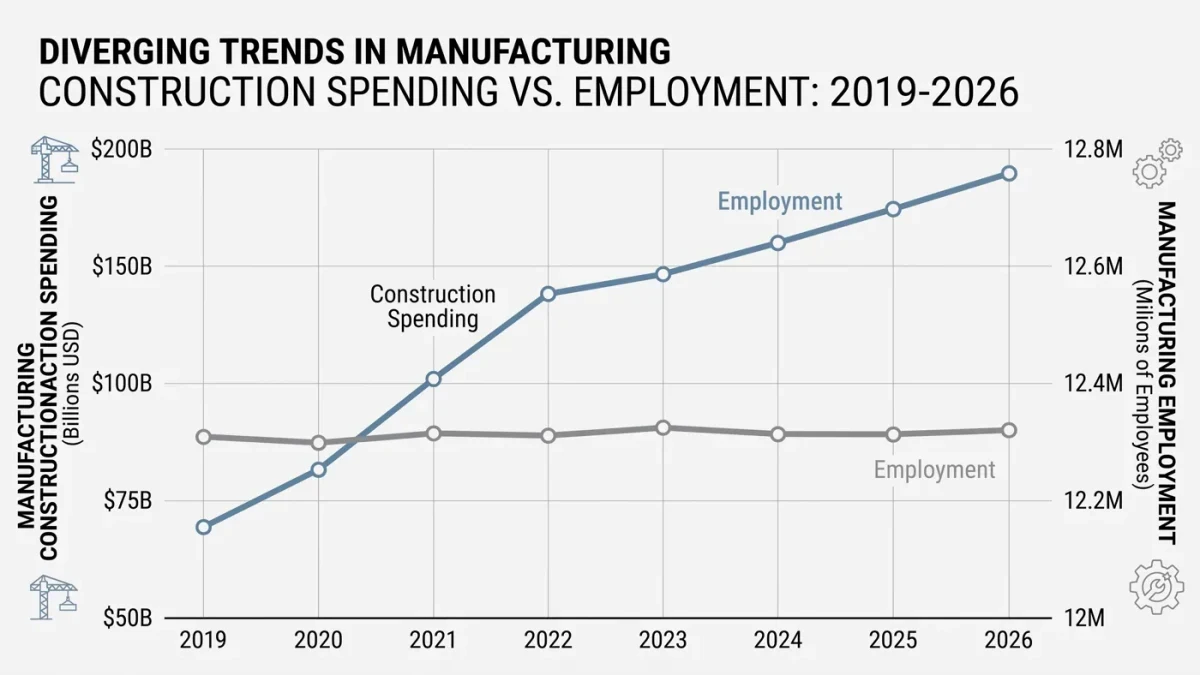
The US nearshoring wave is measurably real in concrete: manufacturing construction spending roughly doubled and then some after 2022, reaching record levels under the CHIPS and Science Act and Inflation Reduction Act incentive programs, per Census Bureau construction data. It is real more slowly in jobs: factory employment recovered its pandemic losses but kept trending roughly flat through 2025, per Bureau of Labor Statistics data. Both facts are true, and the gap between the crane count and the payroll count contains the whole story of this industrial cycle.
What did the subsidy wave actually build?
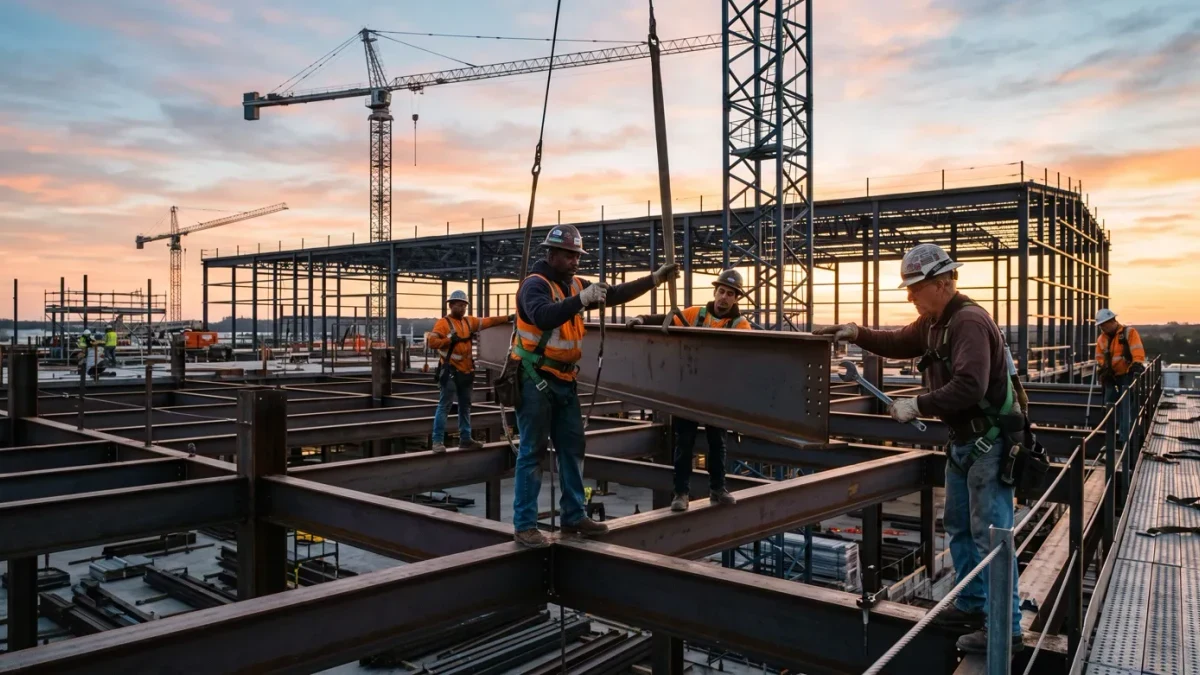
Semiconductor fabs and battery plants, concentrated in a identifiable geography: Arizona and Texas for chips, a southern battery corridor from Michigan through Georgia, plus the steel-and-solar industrial buildout feeding the energy transition. The Commerce Department's CHIPS program office published multi-tens-of-billions in allocated incentives by 2025, with construction timelines running to the end of the decade. Construction spending on manufacturing facilities — the Census series that tracks the cranes — ran at rates several multiples of the 2010s norm.
Why haven't the jobs shown up at the same pace?
Three lags, each documented. Construction jobs came first — and they did show up, in the tens of thousands across fab and battery states. Production jobs wait for the building: fab timelines run three to five years from groundbreaking to volume output, so 2023's construction peak converts to 2026-2027 operations hiring. And when operations arrive, they're capital-intensive: a modern fab employs thousands, not the tens of thousands a mid-century plant did — the productivity story in miniature. Supplier ecosystems — where the broader employment effect theoretically lives — locate near completed plants, adding another lag.
What do the labor-market data show so far?
Durable-goods manufacturing employment roughly recovered its 2020 collapse by 2023 and then plateaued, with aerospace and autos mixed and electronics assembly ticking up in fab-adjacent metros. State-level data tell the regional story better: Arizona, Texas, and the battery-corridor states gained manufacturing employment through 2025 while national totals stayed flat — a redistribution toward build sites rather than a sector-wide jobs boom. Meanwhile, the Institute for Supply Management's surveys and the Fed's regional manufacturing indexes spent 2024-2025 oscillating in contraction-adjacent territory for existing plants even as the new ones rose. Two manufacturing economies, one statistic.
What about the reshoring claim itself?
Mixed, and the researchers who track it say so. The Reshoring Initiative's annual data showed announced reshoring and foreign-direct-investment job gains running at elevated rates through 2023-2024, dominated by the subsidized sectors; trade data showed import ratios in targeted categories like semiconductors beginning to bend only slowly, since capacity takes years. Economists' honest summary through 2025: the policy changed investment decisions genuinely; whether it changes the trade balance and the manufacturing jobs picture at national scale remains open, because the counterfactual baseline (automation trends pre-dating the policy) keeps subtracting jobs even as the new plants add them.
What should workers and communities expect next?
A hiring wave with a narrow funnel. Fabs and battery plants hiring through 2026-2028 need technicians — a middle-skill tier community colleges in fab states spent the subsidy era racing to build programs for, with placement rates those colleges reported proudly. The wage premium is real for that tier. The volume, though, is thousands per site, not the old tens of thousands, and the competition between states for the plants was partly a competition to give away the tax base that would fund the services around them. The nearshoring boom, honestly read, is an industrial-capacity story that delivers a modest, specialized employment dividend — on a delay measured in years.
FAQ
Has nearshoring created US manufacturing jobs?
Construction jobs already arrived in build states; operations jobs follow plant openings in 2026-2028. National manufacturing employment stayed roughly flat through 2025 — the gains are regional, sector-specific, and lagged.
Why did manufacturing construction spending double?
CHIPS and Science Act and Inflation Reduction Act incentives pulled semiconductor fabs and battery plants forward, concentrating record construction in a handful of states through 2023-2025.