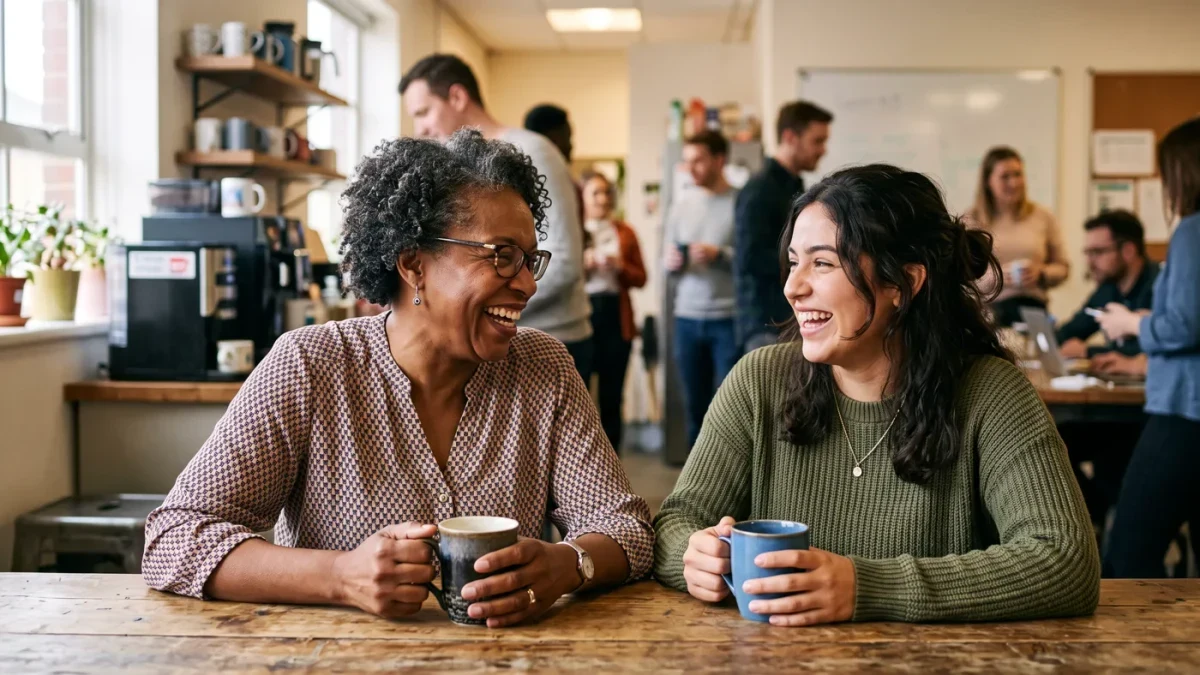
The American workplace stopped making friends. That's a simplification of the data, but not by much: long-running surveys show the share of adults reporting a close friend has fallen for two decades, and the workplace — historically the main place adults form non-family ties — thinned out exactly as hybrid schedules reduced casual contact. By the mid-2020s, workplace researchers were treating friendship decline as an engagement variable, not a soft one.
Amjilt News publishes information, not mental-health advice.
What does the friendship data actually show?
The reference points are two long series. The American Perspectives Survey published by the Survey Center on American Life in 2021 documented the fall in close friendships — Americans reporting no close friends went from about one in ten in the early 1990s to about one in four by 2021, with the drop steepest for men. Gallup's workplace engagement series carries the workplace half: having a best friend at work has been among the strongest predictors of engagement in its polling for decades, and the measured decline in such friendships tracked the remote shift of 2020 onward.
Why did remote work hit friendships specifically?
Because workplace friendship runs on unplanned repetition. Sociologists of network formation going back to the classic proximity studies — and the broadcast-engineer friendship study popularized by the physicist-network research of the 1940s onward — find that repeated incidental contact, not scheduled interaction, builds the weak ties that mature into friendships. A video call is scheduled; the hallway is not. Hybrid schedules cut incidental contact by half or more per week, and onboarding cohorts that never shared a lunch rarely formed the ties their predecessors did. Employee-support vendors' 2024-2025 reports put new-hire social network size measurably below pre-2020 cohorts.
Why should a company care?
Retention and engagement, measurably. Gallup's published analyses attribute a substantial engagement premium to having a best friend at work; its 2024 global workplace report connected declining social connection to engagement drops that cost the economy in productivity terms. The mechanism is unglamorous: employees with workplace friends tolerate friction longer, share information faster, and stay through bad quarters more often. Lonelier teams churn more and coordinate worse — costs that never show up on a line item until exit interviews make them legible.
What are companies trying?
A mix, with uneven results. Structured onboarding cohorts — training groups kept together deliberately — show the best documented returns, because they rebuild the repeated-contact engine where it matters most. Team-level rituals (shared meals on anchor days, rotating project pairings) work at small scale. The failures are predictable: mandatory fun, large generic events, and anything scheduled as "social" but administered as obligation — the same backlash that met forced holiday parties. Vendor platforms for "workplace connection" boomed in the 2020s; the durable effects in published case studies track the ones that simply increased the frequency of small, repeated, optional contact.
Can policy really make friends?
No, and pretending otherwise produces the theater problem. What policy can do is remove the frictions: give hybrid teams shared anchor days that are consistent rather than rotating; protect time in onboarding for cohort formation rather than compliance modules; let managers count small-team rituals as working time instead of scrutinizing them as slacking. The companies reporting improvements describe patience measured in quarters, not offsites. Friendship is an emergent property of repeated low-stakes contact; the employer's job is the repetition, not the friendship.
Is this a business story or a public-health story?
Both, and the workplace is where they intersect. The US Surgeon General's 2023 advisory on loneliness put the health consequences of connection decline in mortality-risk terms comparable to smoking, and singled out workplaces as one of the core institutions that could rebuild connection. Employers that took it seriously discovered the overlap between engagement programs and social infrastructure was nearly total. The office, it turns out, was doing unpaid social work all along — and nobody priced it until it was gone.
FAQ
Does having friends at work improve performance?
Gallup's long series finds a best friend at work is among the strongest engagement predictors, associated with better retention and cooperation. Causality runs partly through selection, but the association is robust across decades.
Can remote teams form friendships?
Yes, but slowly and by design: consistent shared schedules, onboarding cohorts, and repeated small optional contact. Fully random-async teams show the weakest tie formation in vendor and survey data.