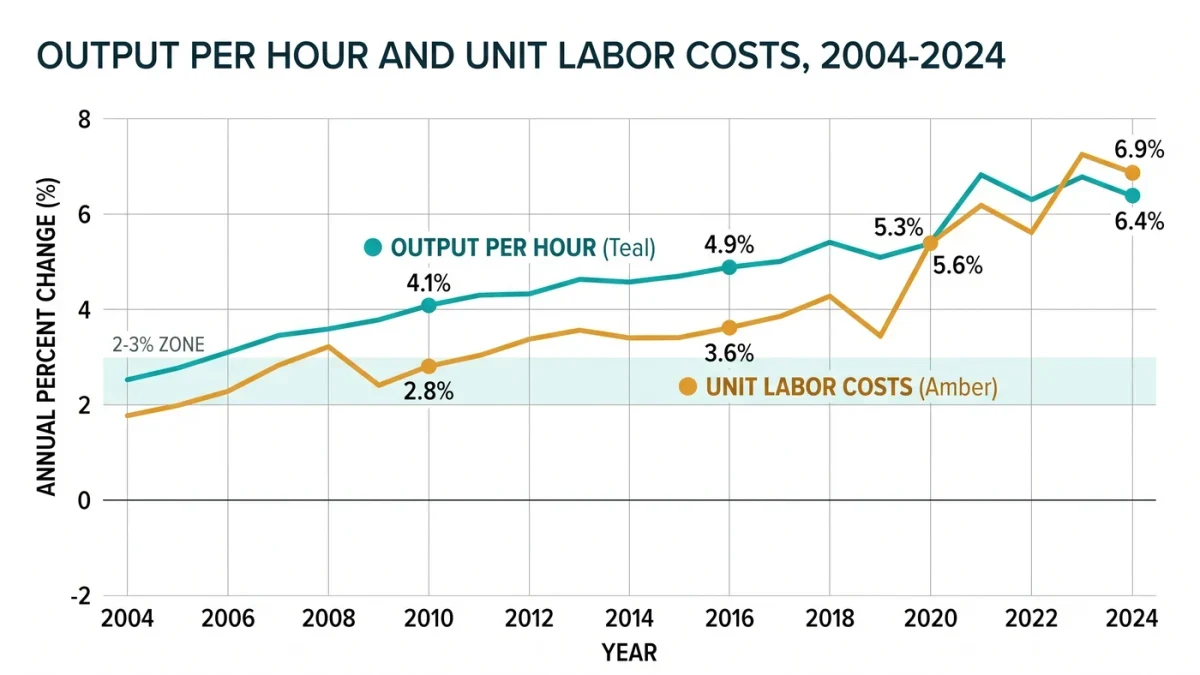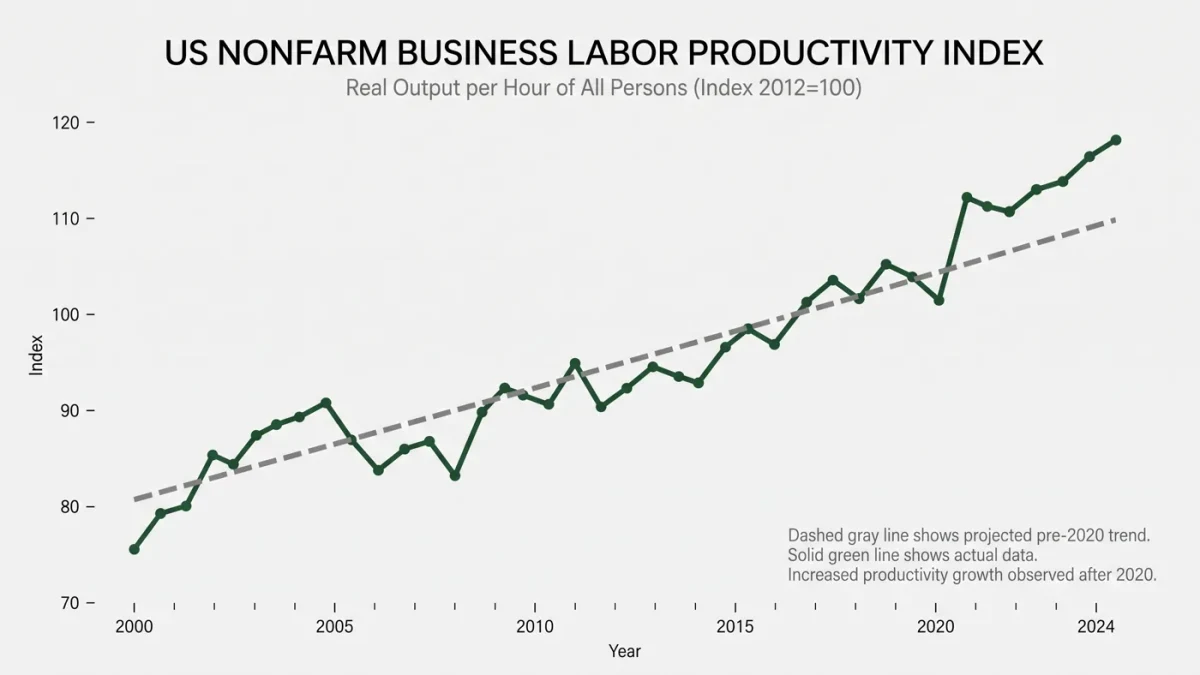
Here's the economic fact the doom coverage keeps omitting: US labor productivity — output per hour — grew materially faster from 2019 through 2025 than during the sluggish 2010-2019 expansion. Bureau of Labor Statistics data showed nonfarm business sector productivity running at roughly twice its pre-pandemic trend pace across the post-2020 period, holding up even as the economy absorbed an inflation shock and a rate cycle. Productivity growth is the entire ballgame for living standards — it's the reason wages can rise without squeezing margins — and the United States spent the mid-2020s outperforming its own recent history and most peer economies on the measure. Why remains genuinely contested.
Amjilt News publishes information, not economic advice.
What are the candidate explanations?
Four, all with evidence and none complete. Remote work: Stanford's Nick Bloom and coauthors' research on hybrid and remote arrangements found positive or neutral productivity effects, contradicting the collar-writers' assumption; if true at scale, the reallocation of millions of commutes into work or rest shows up exactly here. Business formation: the pandemic-era startup surge — Census data showed elevated new-business applications converting into employer firms at high rates — and new firms are, mechanically, where productivity-enhancing churn lives. Labor-market reallocation: the Great Resignation's job-switching matched workers to better-paying, presumably better-fitting employers at record rates. And capital deepening: the investment boom in equipment and intellectual property, including the AI buildout's compute spending, raised capital per hour.
What's the measurement problem?
Serious and acknowledged. Productivity statistics are constructed, not observed — the numerator requires hard-to-measure output in services (what's the output of a nursing unit? a software firm?) and the denominator requires hours that hybrid work blurs. Statistical-agency researchers have documented the pandemic-era measurement strains openly. Two specific puzzles: the goods-sector productivity spike of 2020-2021 partly reflected composition (low-productivity service workers exited the denominator temporarily), and the AI contribution through 2025 was, on most careful readings, not yet visible in the aggregate — the visible spending was, while the measurable output gain lagged, a gap economists described as a possible investment-to-productivity delay like the one that preceded the 1990s IT payoff.
Why does the argument matter?
Because the explanations imply opposite policies. If remote work drives it, return-to-office mandates are quietly destroying measurable output — a hypothesis several CEOs made decisions against, on vibes, while the research ran the other way. If reallocation drives it, labor-market cooling is a productivity risk, not just an inflation cure. If capital deepening and AI drive it, the current investment boom is the seed corn and should be protected. Policy institutions — the Fed, CBO, and the research staffs of the regional Feds — treat the decomposition as an open question because it is one; anyone confidently attributing the whole effect to their preferred cause is selling something.
How does the US compare internationally?
Favorably, unusually. Through the mid-2020s, US productivity growth outpaced the euro area, the UK, and Japan by margins that compounded visibly — a reversal of the 2010s narrative in which European productivity stagnation was the anomaly being explained. Economist and agency analyses pointed to the US combinations: flexible labor markets enabling the churn, deeper capital markets funding the investment, and the technology sector's concentration onshore. Whether the gap persists is among the decade's open macro questions.
How to follow it without fooling yourself
Watch the BLS productivity releases' nonfarm business series, quarterly with annual revisions; check it against real compensation per hour, because productivity gains that never reach wages are a different story than the ones that do; and discount single-quarter swings, which run notoriously noisy. The debate about causes will outlast the data's arrival, as it did through the 1990s. The growth itself, while it lasts, is the rarest economic gift a workforce gets — and for once, the United States has been getting it.
FAQ
Why has US productivity grown faster since 2020?
Candidates include remote-work efficiency, elevated business formation, labor-market reallocation, and capital deepening — likely a combination. Measurement issues and the AI lag complicate attribution.
Does productivity growth raise wages?
Over the long run it's the main constraint on wage growth, though the pass-through has been uneven since the 1970s. Tracking real compensation per hour alongside productivity shows the linkage directly.