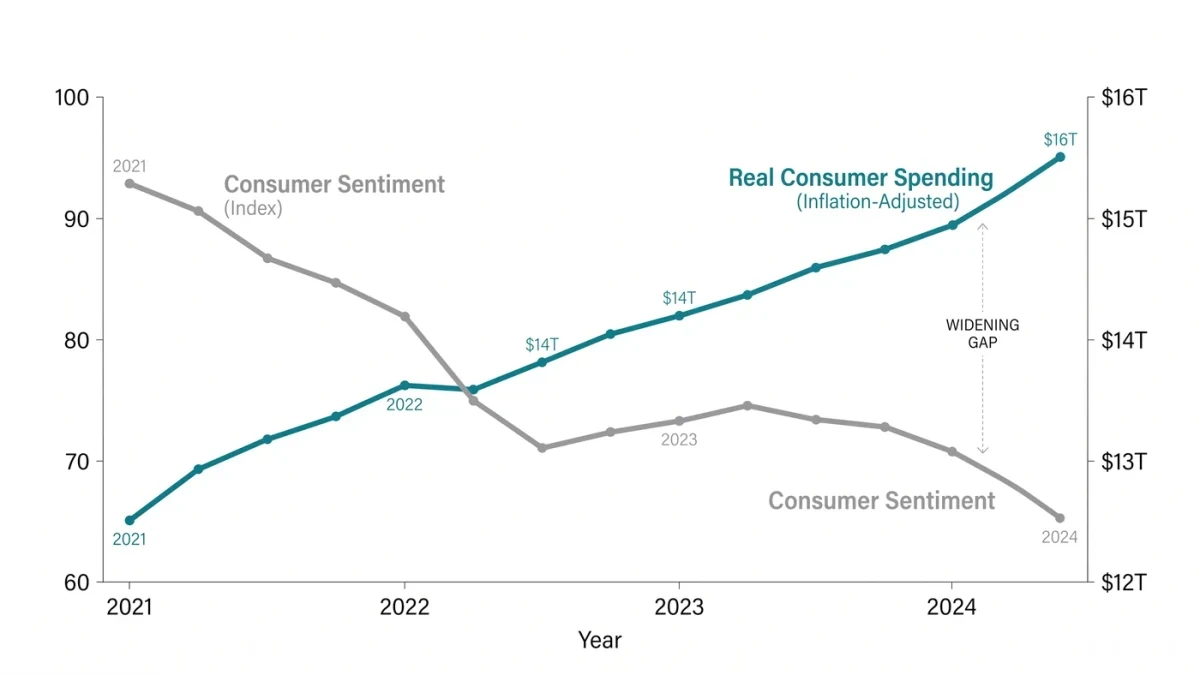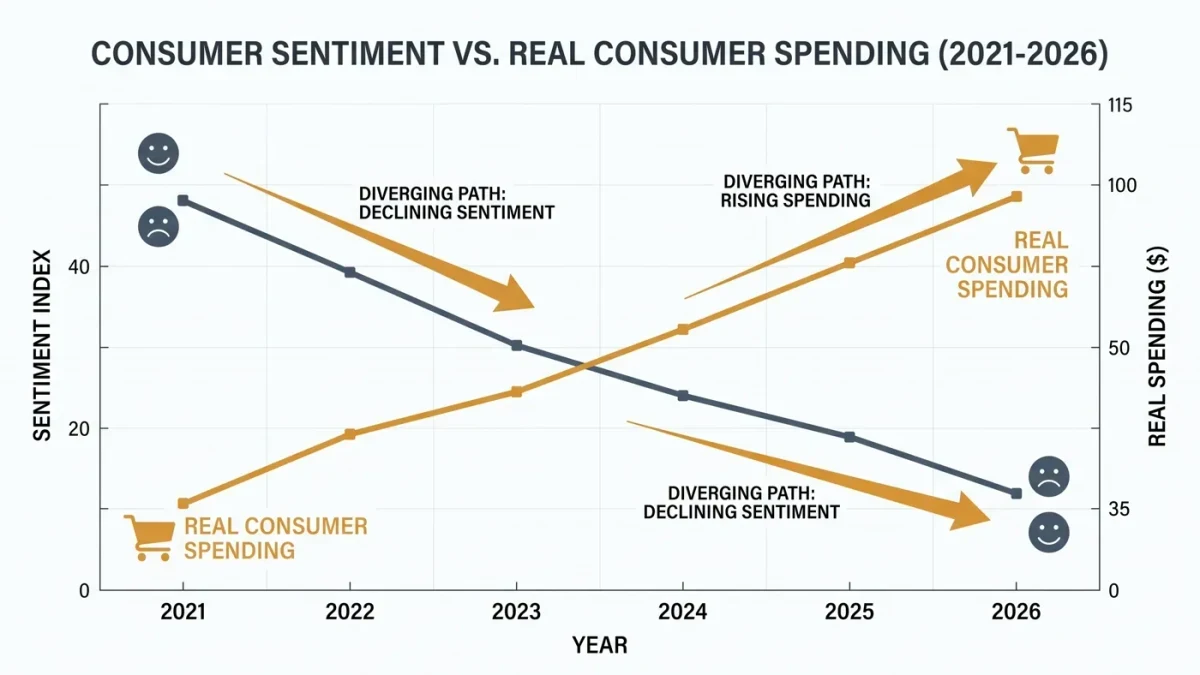
American consumers spent 2025 telling pollsters the economy was in trouble while increasing their inflation-adjusted spending. Both data series are reliable, both are measured well, and both kept pointing in opposite directions — the sentiment-spending divergence that became this expansion's signature puzzle. Understanding why the gap exists matters more than picking which number to believe, because each one answers a different question.
Amjilt News publishes information, not economic or investment advice.
What do the two measures actually say?
The sentiment side: the University of Michigan's long-running index and the Conference Board's consumer confidence series both spent 2024-2025 far below levels historically associated with low unemployment and positive real wage growth. The spending side: Census Bureau retail sales and Bureau of Economic Analysis personal consumption data showed continued real gains, with services spending especially resilient. Reconciling them isn't about error. It's about what each instrument measures.
Why the gap? Three documented explanations.
First, the price level. Sentiment research — including work analyzing Michigan survey microdata — found respondents' answers track the level of prices they remember, not the rate of change. Disinflation makes yearly increases smaller; the groceries still cost a fifth more than in 2021, and people answer the pollster about the groceries.
Second, the question being asked. Sentiment surveys probe feelings about the economy and personal finances, often with explicit political framing effects that researchers documented intensifying since 2016: identical conditions produce partisan-skewed answers. Spending is behavior with money attached, and it responds to income, wealth, and credit — all of which held up through 2025.
Third, distribution. The households most negative in surveys — younger renters with student debt, for instance — are a smaller share of total spending than older homeowners whose wealth rose with asset prices. Aggregate spending can stay strong while a large minority of voices in surveys report genuine strain. Both experiences are real; they belong to different people.
Which number predicts the future?
Spending, with a caveat. Personal consumption is roughly two-thirds of GDP, and real spending data leads recessions more dependably than sentiment does — sentiment's recession-forecasting record is weak enough that economists treat it mainly as a psychological and political indicator. The caveat: sentiment that stays depressed for years can eventually become self-fulfilling through the consumer expectations channel the Federal Reserve watches in its own surveys, since expectations influence wage demands and price-setting. Persistent gloom is not nothing, even when the cash registers disagree.
What were both numbers doing as of early 2026?
Spending growth continued but cooled from its 2024 pace, consistent with a labor market normalizing rather than cracking — monthly payroll gains slowed, unemployment stayed historically low. Sentiment recovered partially from its worst readings but remained well below its historical average, an asymmetry researchers attribute to price-level memory plus partisan amplification. The divergence narrowed at the edges; it did not close.
How to read consumer numbers without getting played
Three habits. Match the month: sentiment and spending get compared across different periods to manufacture headlines; align the vintages first. Check real versus nominal: a spending "surge" that matches inflation is no surge. And disaggregate when you can: the Census retail categories and the Fed's distributional data show which households are actually pulling back — in 2025 that was lower-income discretionary categories, which told a truer story than either headline aggregate.
FAQ
Is consumer spending or consumer sentiment a better economic indicator?
Spending, for forecasting: consumption drives GDP and its slowdowns lead recessions more reliably. Sentiment better tracks psychology, politics, and how price levels feel to households.
Why is consumer sentiment so bad if spending is strong?
Price-level memory, partisan framing in survey answers, and distribution: the households answering most negatively account for a smaller share of total spending.