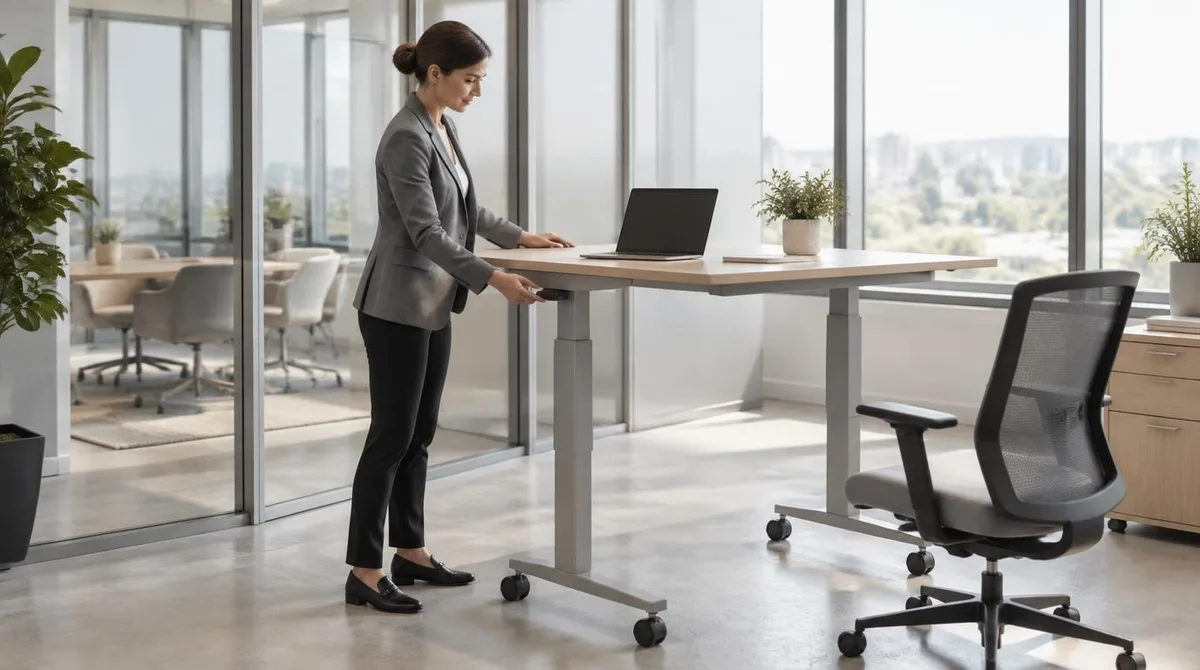
Workplace modular systems — movable desks, reconfigurable walls, bookable neighborhoods — do help productivity, collaboration, and cost. But the mechanism is not flexibility itself. It is fit: whether the reconfigured space fits the bodies, tasks, and work patterns of the people using it. Get that wrong and a modular office is just an expensive way to move a problem around the floor.
The evidence for that distinction comes from an old discipline wearing a new outfit. Ergonomics — the science of fitting work to the person, not the reverse — has documented for decades that layout, posture, and work design drive both injury and output. When companies redesign offices around those principles first and the furniture catalog second, the numbers tend to follow.
What does "modular" actually mean in an office?
Strip away the showroom language and a workplace modular system is three things. First, physical modularity: desks on wheels, demountable partitions, furniture that can be rebuilt in an afternoon. Second, allocation modularity: neighborhoods, hoteling, and booking systems that assign space by the day rather than the decade. Third, organizational modularity: schedules, team compositions, and workflows designed to change without a crisis.
That third layer is the one buyers forget. The International Ergonomics Association defines organizational ergonomics as the optimization of sociotechnical systems — structures, policies, and processes — alongside the physical workspace. A company that buys movable walls but keeps rigid work methods has modularized one-third of the problem.
Does a flexible layout actually raise productivity?
Yes, when the change is ergonomic rather than merely cosmetic. A Washington State study of office ergonomics found a median productivity increase of 12% following an ergonomic intervention — enough, the researchers noted, for an adjustable desk or a proper chair to pay for itself within months. The gains came from fitting workstations to people, not from rearranging them.
The productivity story has a cognitive branch too. The same field covers mental workload: how many clicks a task takes, how information is displayed, how much a person must hold in their head. One cited study found a redesigned patient monitor display led to a 78% higher probability of correctly identifying the cause of a medical emergency. An open, reconfigurable floor plan that adds noise, sightline distractions, and wayfinding friction works against that branch entirely.
What does the injury data say?
This is where the cost case gets concrete. According to Wikipedia's overview of ergonomics, 1.8 million U.S. workers experience work-related musculoskeletal disorders every year, and nearly 600,000 of those injuries are serious enough to cause missed work. In the UK, 543,000 workers suffered work-related musculoskeletal disorders in 2023–24, at an estimated cost of 7.8 million lost working days.
Those numbers are the hidden invoice on a bad modular rollout. Movable furniture that cannot be adjusted — fixed-height tables, monitor arms bolted to shared benches — guarantees that no setting fits anyone. Ergonomic design relies on anthropometry, the science of body measurement, precisely because bodies vary so much. Designers typically aim to accommodate the 5th to the 95th percentile; a shared fixed desk accommodates roughly nobody.
OSHA's position is blunt. The agency states that ergonomics — fitting a job to a person — lessens muscle fatigue, increases productivity, and reduces the number and severity of work-related musculoskeletal disorders, which are among the most frequently reported causes of lost or restricted work time.
What does OSHA say makes a redesign stick?
The agency's framework reads like a checklist for any modular rollout, and none of it is about furniture. The elements OSHA identifies:
- Management support. Clear goals, assigned responsibility, and communication from leadership.
- Worker involvement. A participatory approach where employees help assess workstations, propose fixes, and evaluate the results.
- Training — so people understand the risks and report early symptoms.
- Problem identification before injuries occur, using injury logs and job analyses.
- Early reporting of symptoms, which accelerates fixes and prevents lost-time claims.
- Implementation and evaluation — solutions deployed, then checked, as an ongoing function rather than a one-time project.
That last point is the quiet argument against the big-bang office reveal. OSHA frames an ergonomic process as something incorporated into daily operations, not an individual project. A modular system is only modular if it keeps being adjusted after the ribbon is cut.
How do you avoid the collaboration trap?
Flexible layouts are usually sold on collaboration, and that is where they most often disappoint. Proximity does not manufacture cooperation; it relocates the friction. We have covered this pattern before: return-to-office mandates didn't fix collaboration, they relocated it. The same logic applies to knocking down walls. If the underlying work design — who needs to talk to whom, about what, when — hasn't changed, a new floor plan just changes where the silence happens. This connects to our earlier piece, Return-to-office mandates didn't fix collaboration. They relocated it..
Space allocation carries its own politics. Hoteling was supposed to be neutral, but the seat map says otherwise: when desks are booked rather than owned, status and access reassert themselves through who gets the window, the quiet corner, the room with the door. A modular system needs explicit rules for allocation, or it inherits the hierarchy it was meant to dissolve. For related coverage, see Hoteling was supposed to be neutral. The seat map says otherwise..
What this means in practice: treat the physical modularity as the easy part. The durable gains come from the boring disciplines — participatory assessment, adjustable everything, early symptom reporting, and honest rules about who sits where.
Our analysis: what's durable here
The pattern across the evidence is consistent. Ergonomics programs cut workers' compensation costs, raise productivity, and reduce turnover, per OSHA's own finding of substantial evidence. The 12% median productivity gain from ergonomic intervention dwarfs anything a furniture vendor can promise. And the fields' own framing — physical, cognitive, organizational — is a useful audit tool for any modular proposal: if a vendor's pitch only addresses the first, it is selling half a system.
What remains unknown is how these gains interact with hybrid schedules, since most published ergonomic research predates the current mix of home and office days. The honest reading: modular systems that put fit first have a strong evidence base. Modular systems that put flexibility first are still mostly a bet on aesthetics.