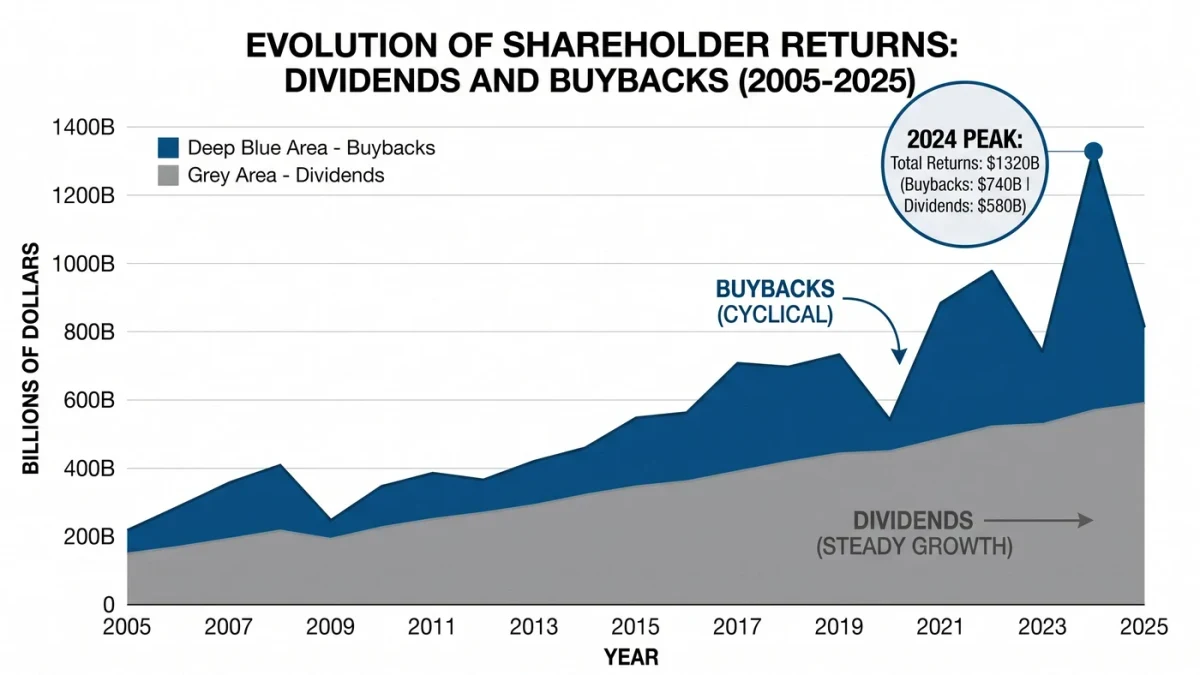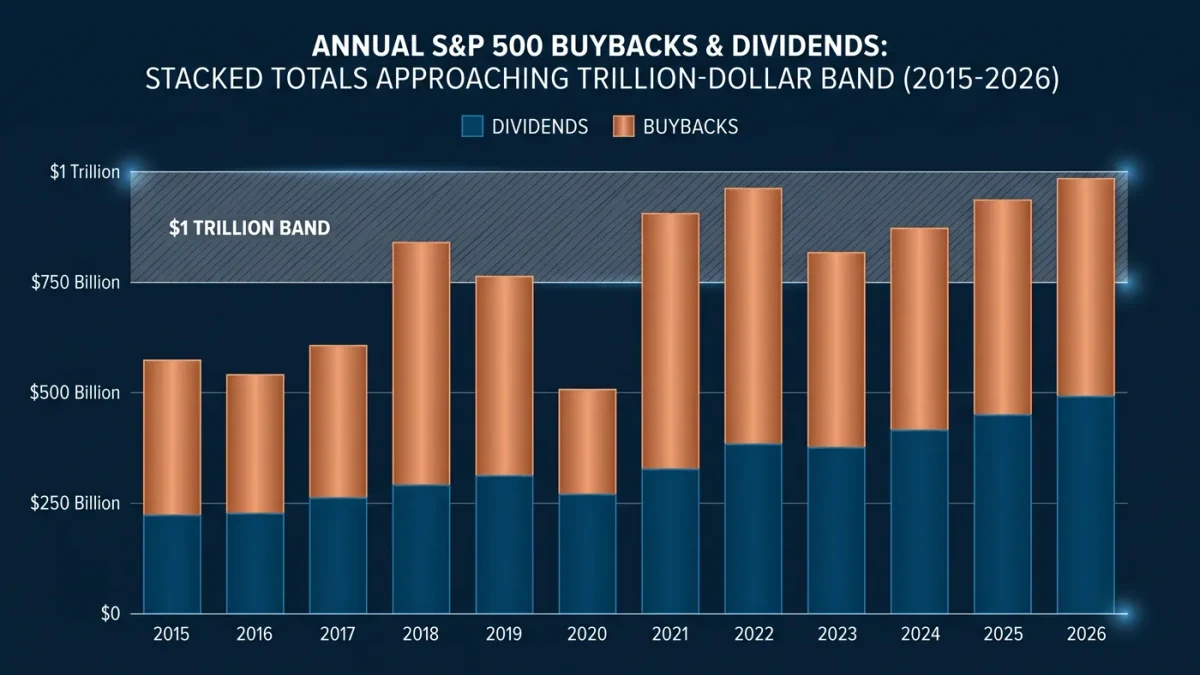
Corporate capital returns kept setting records after the practice stopped being controversial. S&P 500 companies spent hundreds of billions annually on buybacks through 2024-2026 — S&P Dow Jones Indices' tracking showed buyback totals running near their all-time highs around the trillion-dollar mark — plus comparable flows to dividends. The Inflation Reduction Act's one-percent excise tax, imposed in 2023 amid political heat, functioned as a rounding adjustment. The fight moved from whether companies should return cash to what else they could possibly do with it.
Amjilt News publishes information, not investment advice.
Why did buybacks stay so large?
Cash generation and a dearth of alternatives. Mega-cap technology and AI-adjacent companies generate operating cash beyond any plausible reinvestment need — the same firms funding historic capital expenditure on data centers simultaneously returned tens of billions quarterly — and managements facing that arithmetic lean on the two outlets the SEC permits: dividends and repurchases. The rate environment reinforced it: with borrowing costs well above the 2010s, debt-funded financial engineering thinned while cash-funded returns grew. Repurchases also carry the quiet accounting appeal of shrinking the share count, which lifts per-share numbers without any operational improvement — the criticism's core, and the market's shrug.
What did the excise tax change?
Timing, mostly. The 1 percent tax applies to net repurchases — buybacks minus new issuances — and its documented effects through 2024-2025 were procedural: slightly more disclosure work, marginally more attention to gross-versus-net mechanics, and a modest nudge toward dividends (untaxed by the excise) for companies at the margin. Academic and market-structure analyses found no evidence it deterred the practice at scale; a tax of one percent against managements' conviction that their stock is undervalued is a toll, not a wall. The political energy behind proposals to ban or heavily tax buybacks — prominent in 2018-2022 — dissipated with the election cycles.
What's the honest critique?
The allocation argument: cash returned to shareholders is cash not spent on wages, R&D beyond the strategic core, or capacity — and the research record on whether buybacks starve investment is genuinely mixed, with studies finding crowd-out effects in some firm samples and no discernible investment suppression in others. The manipulation argument: buybacks concentrated around earnings windows and executive equity vesting drew SEC enforcement actions for timing coordination, and the Commission's disclosure amendments of 2023-2024 requiring daily repurchase reporting tightened that particular game. The labor argument: layoffs concurrent with buybacks generate the loudest headlines and the weakest causal analysis — the same companies cutting one function while returning capital are usually hiring in another, the reallocation pattern again.
What did the 2026 season look like?
Record-ish, AI-shaped, and quieter. The largest programs belonged to the mega-cap technology cohort whose AI-driven cash flows compounded through 2025; announcements of a hundred-billion-plus annual authorization became routine for the biggest names. Dividend growth ran mid-single-digit across the index, with initiations spreading among profitable mid-caps that entered the public markets through the reopened IPO window — the mature-company cohort the new listings market selected for. And the disclosure regime finally let outside observers see the daily mechanics, which produced better journalism and fewer scandals: sunlight did its usual work.
Why should anyone outside the market care?
Because capital returns are the endpoint of a chain that starts with pricing power. Record cash generation reflects margins that consumers and other businesses pay for; the allocation choice — data center versus dividend versus buyback versus wage — is one of the highest-leverage decisions in the economy, made by a few hundred boards under incentives that tilt toward measurable, per-share outcomes. The 2020s settled the political question in favor of permissiveness. The 2010s-era dream of directing that cash elsewhere will have to find a different mechanism than the excise tax turned out to be.
FAQ
Are stock buybacks still legal?
Yes, fully, subject to SEC rules and since 2023 a one-percent federal excise tax on net repurchases. The tax raised paperwork, not barriers — buybacks ran near record levels through 2024-2026.
Do buybacks hurt employees?
The direct evidence is mixed: some studies find reduced investment in heavy-repurchase firms, others find no crowd-out. The loud layoffs-plus-buyback juxtapositions usually reflect reallocation across functions rather than cash diverted from payroll.